Introduction
Bird infestations in warehouses create serious operational and health challenges that demand a professional, customized solution. Pigeons and other urban birds contaminate inventory, damage stored goods, block ventilation systems, and create slip hazards from droppings. Unlike residential properties where one balcony needs protection, warehouses present large-scale infestation challenges requiring systematic, comprehensive bird control.
The warehouse bird problem is different:
- Flat roofs attract massive roosting colonies
- Large perimeter ledges and ductwork provide multiple entry points and landing zones
- Inventory contamination poses a serious risk to stored goods and food safety
- Food storage facilities face regulatory pressure to maintain a bird-free environment
- HVAC systems can be compromised, affecting climate control for sensitive goods
Commercial-grade bird spikes are the most effective, long-term solution for warehouse bird control in Dubai. However, professional installation requires different planning, materials, and execution than residential projects. For a broader look at protecting large properties, see our complete guide to commercial bird control solutions for buildings.
This guide covers everything warehouse managers and facility owners need to know about implementing a comprehensive bird deterrent system across large commercial properties.
Why Warehouses Attract Birds and Become Infested
Understanding why birds invade and roost on warehouses is the first step toward effective, targeted bird control.
Warehouse Features That Invite Bird Infestation
Flat roofs and parapets
- Ideal nesting and roosting habitat
- Protected from predators and weather
- Clear view of surroundings for early warning
- Easy takeoff and landing zones
Ventilation systems and equipment
- Heat from mechanical systems attracts birds in cooler months
- Air vents and exhaust ducts provide shelter and entry points
- Equipment ledges create perching and nesting spots
Ledges and architectural features
- Building edges and corners
- Gutter systems
- Equipment mounting points
- Signage and antennae
Open loading areas
- Exposed goods attract foraging birds
- Large uncovered spaces lack natural predator protection
- Spillage from goods handling creates a food source
- Minimal barriers to entry
Water sources
- Condensation from cooling systems
- Rainwater pooling on flat roofs
- Drainage areas and gutters
- Proximity to water features (canals, irrigation channels)
Identifying Bird Species: Why It Matters for Treatment
Knowing which birds you’re dealing with determines the right spike spacing and customized control strategy.
Pigeons (most common warehouse pest)
- Highly adaptable to urban environments
- Form large, persistent roosting colonies
- Aggressive competitors for space
- Produce significant contamination from droppings
Sparrows and starlings
- Smaller birds requiring closer spike spacing
- Nest inside structures if given access
- Prolific breeders — multiply rapidly without control
- Less dramatic but persistent infestation risk
Crows and ravens
- Highly intelligent; may avoid some deterrents
- Create mess from food caching
- Aggressive toward other birds
- Require strategic, professional spike placement
Seagulls (near coastal warehouses)
- Larger and more aggressive
- Travel further inland in Dubai
- Harder to deter; require heavy-duty, commercial-grade spikes
Why Bird Spikes Outperform Other Warehouse Bird Control Methods
Warehouse managers need an effective, long-term bird control solution that doesn’t require constant reinvestment. Understanding how each method performs helps you choose the right protection for your facility.
Bird spikes
- One-time professional installation
- No recurring chemical reapplication or live-trapping cycles
- Long design lifespan with minimal upkeep
- Eliminates lost inventory and contamination risk
- No ongoing safety concerns for employees
- Regulatory compliant across all Dubai jurisdictions
Bird netting
- Requires periodic cleaning and repair
- Degrades faster under Dubai’s intense UV exposure
- Best suited for full-area exclusion rather than ledge protection
Chemical deterrents (gels/sprays)
- Requires repeated reapplication throughout the year
- Variable effectiveness; birds often adapt and return
Live trapping and removal
- Addresses individual birds, not the underlying infestation
- Birds return without a permanent physical barrier
- Requires ongoing professional animal control visits
Electrified perches
- Requires ongoing power and maintenance
- Raises ethical and regulatory concerns in Dubai
The Warehouse Bird Control Conclusion
Bird spikes for warehouses offer the most reliable, long-term protection:
✓ One-time professional installation vs. repeated treatments ✓ Long design lifespan with minimal maintenance ✓ Eliminates lost inventory and contamination ✓ No employee safety concerns ✓ Fully compliant in all Dubai jurisdictions
Warehouse Spike Installation: Scale and Complexity
Commercial warehouse bird control differs significantly from a single residential treatment.
Linear Footage and Protection Zones
Most Dubai warehouses need a comprehensive bird spike installation across multiple high-risk areas:
| Area | Priority | Why It Matters |
|---|---|---|
| Roof perimeter | High | Primary roosting zone |
| Gutter systems | High | Easy landing access |
| HVAC equipment ledges | High | Internal contamination risk |
| Loading dock edges | Medium | Inventory protection |
| Parapet walls | Medium | Secondary roosting |
| Interior ductwork/beams | Low | Relevant if interior access exists |
This scale of protection requires careful, professional planning and execution to ensure effective, lasting results.
Complexity Factors Unique to Warehouses
Height and access challenges
- Warehouses often reach 8–12 meters (3–4 stories)
- Specialized scaffolding or lift equipment required
- Insurance and safety certification necessary
- Installation for large facilities typically spans several weeks
Roof structure variation
- Multiple roof levels and valleys
- Uneven surfaces requiring custom spike angles
- Existing equipment complicating installation
- Weatherproofing requirements more critical at scale
Operational continuity
- Warehouses can’t simply shut down for installation
- Work must coordinate with operational schedules
- Safety protocols must protect staff and inventory
- Noise and dust control essential during treatment
Regulatory compliance
- Some warehouses require building permits for roof work
- Safety certifications required for technicians working at height
- Insurance documentation needed for liability
- Food storage and pharmaceutical facilities face stricter requirements
Commercial-Grade Spike Materials for Warehouses
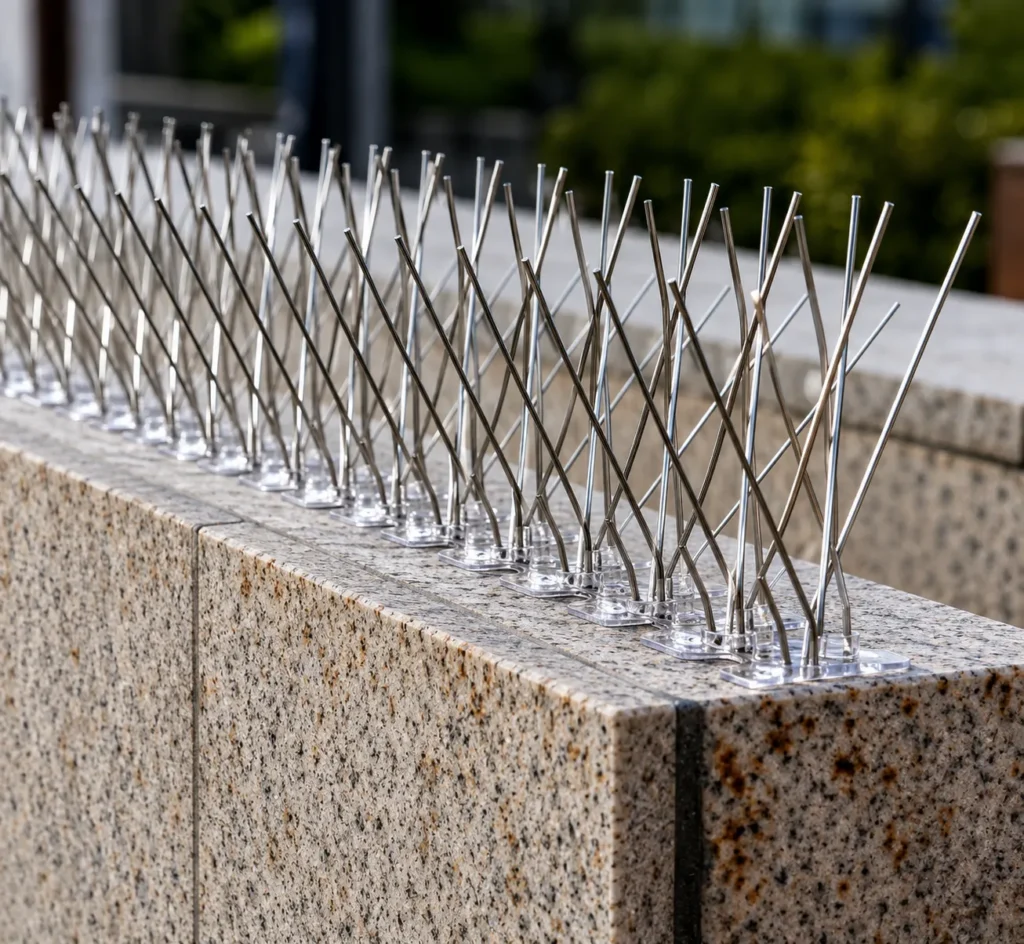
Residential-grade spikes often fail on warehouses. Understanding material differences ensures durable, effective protection. See our full breakdown of stainless steel bird spikes for a closer look at why this material outperforms plastic alternatives.
Stainless Steel Specifications
Why certified stainless steel is essential for commercial warehouses:
Standard stainless steel (304 grade) is the minimum acceptable material for commercial use:
- Long-term corrosion resistance in Dubai’s salt-air environment
- Temperature stability across extreme seasonal swings
- UV resistance that maintains structural integrity under intense sun
- Load-bearing capacity to support accumulated dust, debris, and water
Superior option: 316-grade stainless steel
- Enhanced corrosion resistance for the longest design lifespan
- Recommended for coastal warehouses
- Often specified in food storage facilities
Spike Design Variations
Commercial-grade differences:
- Thicker gauge wire that resists bending from larger birds
- Wider base strips that distribute load across larger areas
- Reinforced mounting points that handle wind stress on tall buildings
- Modular design for easy section replacement
Spike tip designs:
- Blunt tips for pigeons and large birds
- Finer tips for smaller birds (sparrows, starlings)
- Mixed-tip configurations for multiple bird species
- Flexible tips that reduce infrastructure damage and improve durability
Fastening Hardware Specifications
Concrete fastening:
- Heavy-duty wedge anchors
- Minimum ⅜” diameter bolts
- Stainless steel or galvanized hardware
- Close spacing for proper load distribution
Metal surface fastening:
- Heavy-duty rivet nuts or threaded inserts
- Grade 8 stainless steel bolts
- Locking washers to prevent vibration loosening
- Tight fastener spacing for commercial durability
Sealant and waterproofing:
- Polyurethane sealant rated for Dubai’s full temperature range
- Marine-grade sealant for coastal warehouses
- Applied at commercial-grade thickness
- Scheduled reapplication as part of ongoing maintenance
Phase 1: Pre-Installation Inspection and Assessment
Comprehensive Site Survey and Documentation
Every professional warehouse bird control project begins with a thorough interior and exterior inspection.
Property mapping:
- Photograph entire perimeter (drone photography recommended for large facilities)
- Identify all bird roosting and nesting sites
- Mark structural obstacles (equipment, vents, antennae)
- Document surface conditions and prior deterrent attempts
- Note building orientation relative to sun exposure
Bird activity assessment:
- Conduct morning observation during peak activity
- Count roosting populations in key hotspots
- Document entry points and access routes
- Identify nesting sites birds will return to
- Confirm bird species present to customize spike spacing
Surface condition evaluation:
- Test concrete integrity for spalling or weak areas
- Assess metal surfaces for rust or corrosion
- Check existing sealant condition
- Identify areas requiring repair before installation
- Document load-bearing capacity of structures
Structural Engineering Considerations
Certified structural review is essential when:
- The building is a historic or heritage structure with specific codes
- The roof has unusual structures or significant spans
- Pre-existing structural damage or concerns are present
- The building exceeds 15 meters in height
- Additional loading concerns exist beyond spike weight
What a professional structural review determines:
- Safe fastening methods for your specific structure
- Load-bearing capacity of the spike installation
- Additional reinforcement requirements
- Potential stress points requiring special attention
Permitting and Regulatory Compliance
Licensed contractors navigate Dubai’s permit requirements so you don’t have to.
Typical requirements include:
- Building permit application (common in Jebel Ali, Dubai Industrial City)
- Safety plan documentation
- Contractor licensing verification
- Proof of insurance
- Work schedule and methodology
Free zones with their own requirements include Jafza (Jebel Ali Free Zone), Dubai Customs, Dubai Silicon Oasis, and other designated free zones. DIY attempts often run into compliance issues that a licensed, professional installer avoids entirely.
Phase 2: Surface Preparation at Warehouse Scale
Large-Scale Cleaning Requirements
Thorough surface preparation is the foundation of a lasting bird spike installation.
- Debris removal: Clear leaves, dirt, and construction debris from roof surfaces
- Pressure washing: Commercial-grade pressure washing for concrete surfaces
- Chemical cleaning: Degrease surfaces with accumulated bird droppings
- Rust removal: Wire brush metal surfaces; apply chemical rust remover as needed
- Moisture management: Allow sufficient drying time in Dubai’s humidity
Why thorough cleaning matters:
- Improper adhesion is the leading cause of warehouse spike failure
- Crumbling concrete or heavy rust prevents proper fastener seating
- Bird droppings contain uric acid that weakens concrete bonds
- Dust and debris under spikes causes water entrapment
Structural Repair Before Installation
Common repairs identified during inspection:
- Concrete spalling: Remove deteriorated areas; apply concrete patching
- Rust remediation: Sand and treat metal surfaces; apply rust-inhibiting primer
- Failed sealant: Remove old sealant; prepare joint for new application
- Crack repair: Fill significant cracks; assess for underlying structural issues
Skipping these repairs leads to premature spike failure and costly reinstallation — proper preparation protects your investment for the long term.
Equipment and Staging
Access equipment:
- Boom lifts for high warehouses
- Scaffolding systems for complex multi-level roofs
- Fall protection systems (safety harnesses, anchor points)
- Power equipment (drills, pressure washers, pneumatic fastening tools)
Material staging:
- Organize spike strips by installation area
- Stage fasteners, sealant, and tools on-roof to minimize trips
- Establish staging areas away from active operations
- Plan delivery logistics for large-scale installations
Phase 3: Commercial Installation Methodology
Systematic, Professional Installation Approach
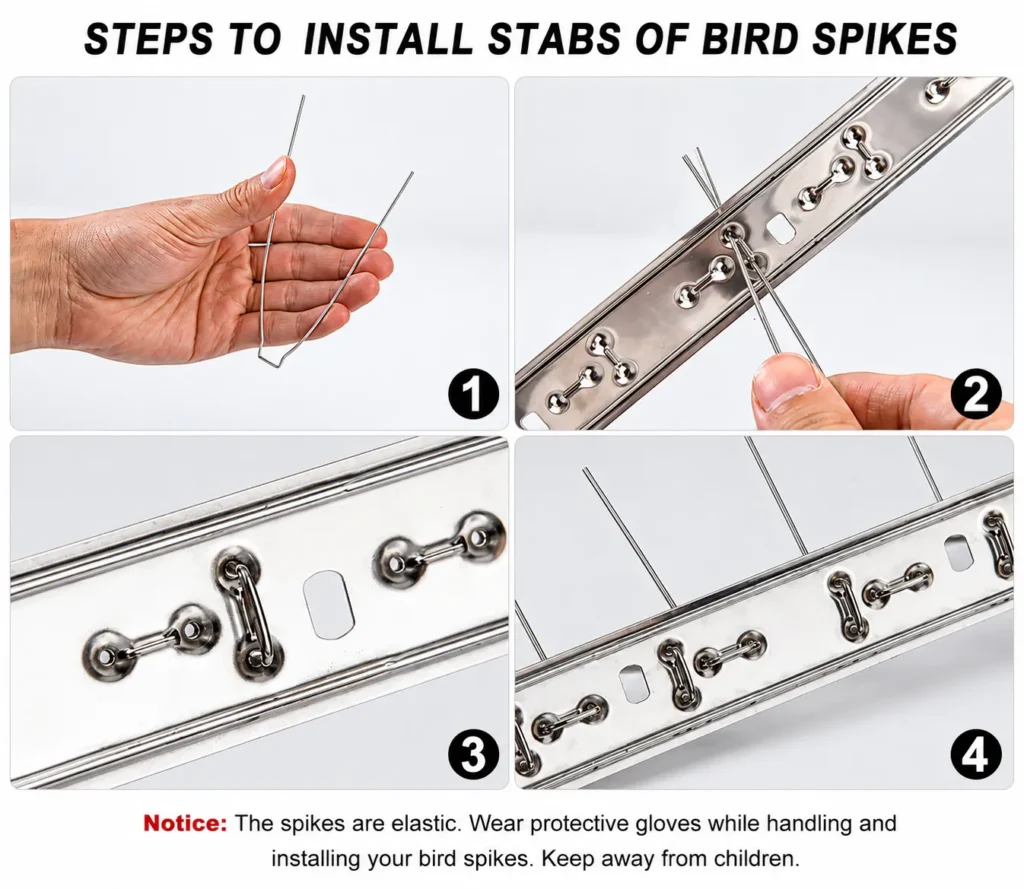
Large warehouses require a structured, sequenced methodology:
- High-risk areas first (roof perimeter, primary roosting zones)
- Secondary areas (gutters, equipment ledges, parapets)
- Tertiary protection (loading docks, internal ductwork)
- Ongoing quality verification during installation
- Final inspection and complete documentation
Weather Considerations in Dubai
Seasonal planning:
- June–August: Extreme heat makes outdoor work difficult
- October–March: Ideal installation season
- April–May, September: Workable with heat precautions
- November–February: Weatherproofing planned around potential rain
Temperature-dependent processes:
- Adhesive application performs best in moderate temperatures, often requiring early morning or evening work
- Concrete curing takes longer in extreme heat
- Sealant cure requires an extended window at moderate temperatures
Dust and sandstorm considerations:
- Equipment must be protected from dust
- Sealant application may be scheduled around low-dust days
- Surface cleaning is ongoing throughout the project
Crew Requirements and Expertise
A professional installation crew typically includes:
- Project manager: Oversees timeline, quality, and safety
- Lead installer: Highly experienced, trained in fall protection
- Installation crew: Sized to the warehouse’s scope
- Safety officer: Ensures compliance with fall protection standards
- Quality inspector: Conducts intermediate and final inspections
Required certifications:
- Fall protection training for work at height
- Harness and anchor point installation certification
- First aid and emergency procedures
- Site safety documentation
Individual contractors or small teams often lack these resources — this is why certified, licensed professional installation is standard for warehouse projects.
Bird Spikes vs. Warehouse Netting: Which Solution Is Right for You?
Bird Spikes Are Ideal for Warehouses Because: ✓ Long-term, low-maintenance protection ✓ No ongoing water drainage concerns ✓ Doesn’t create wind resistance ✓ Doesn’t accumulate dust and debris ✓ Maintains warehouse aesthetics ✓ Works on equipment and ductwork ✓ Compatible with HVAC systems
Bird Netting Is Better for Specific Situations: (see our full bird netting service page) ✓ Complete area exclusion is needed ✓ Protecting entire roof zones from entry ✓ Temporary or short-term installation ✓ Interior courtyard protection ✓ Temporary facility protection
Best practice: combine both solutions strategically. Use spikes for roofline and equipment protection; use netting for fully enclosed courtyards or temporary exclusion zones. For a side-by-side breakdown, read our comparison of bird spikes vs. netting vs. pigeon spikes.
Regulatory Compliance for Warehouse Bird Control
Food Storage and Processing Facilities
DAFZA (Dubai Agricultural and Food Safety Authority) requirements:
- Bird control systems must be documented
- Inspections occur regularly
- Failure to maintain a bird-free environment can result in facility shutdown
- Bird spikes are the preferred DAFZA-approved solution
Hazard analysis requirements:
- Food facilities must document bird control as part of their food safety plan
- Regular inspection reports required
- Contractor certifications and qualifications must be on file
Pharmaceutical and Medical Facilities
GMP (Good Manufacturing Practice) compliance:
- Contamination prevention is critical
- Bird control systems must be part of facility documentation
- Professional installation with certification is often required
- Annual compliance audits include bird control verification
Free Zone Facilities
JAFZA and other free zones may have specific pest control requirements, varying contractor licensing rules, permit requirements for roof work, and mandatory compliance documentation.
Long-Term Warehouse Spike Maintenance
Annual Maintenance Program
Visual inspection — full perimeter walkthrough to identify loose or damaged spikes, check fastener condition, look for corrosion, and document changes in bird activity.
Fastener tightening — Dubai’s temperature swings cause seasonal fastener movement; annual retightening prevents loosening, and corroded fasteners are replaced immediately.
Sealant inspection — checking for cracks or separation, inspecting joint integrity, and identifying areas needing resealing.
Cleaning and debris removal — clearing accumulated dust and debris, removing nesting material or droppings, and cleaning gutters and drainage areas.
Pest activity monitoring — documenting bird species present, counting roosting populations, and identifying new problem areas or trends.
Every 3-Year Deep Maintenance
Professional inspection — third-party evaluation including detailed fastener assessment, structural integrity check, photography documentation, and a written report with recommendations.
Sealant replacement — removing degraded sealant, cleaning joints thoroughly, and applying new polyurethane sealant with a full cure period.
Fastener replacement — replacing corroded or damaged fasteners and upgrading hardware where improvements are available.
Spike section replacement — addressing bent, cracked, or damaged spikes by replacing entire strips for consistency, angle, and spacing.
Documentation and Record-Keeping
Professional warehouse installations include:
- Installation documentation (photos, measurements, materials used)
- Maintenance logs (dates, work performed, contractor information)
- Inspection reports (third-party assessments and recommendations)
- Warranty information (material and workmanship coverage)
- Maintenance schedule for upcoming work
This documentation demonstrates due diligence for compliance inspections, supports insurance claims, shows maintenance history to potential property buyers, and provides a baseline for comparing installation quality.
Common Warehouse Spike Installation Failures
Failure #1: Inadequate Fastening on Large Spans
What happens: Spikes loosen after months, then fail during high winds. Prevention: Closer fastener spacing, properly sized heavy-duty anchors, and professional engineering assessment for unusual roof structures.
Failure #2: Moisture Entrapment and Accelerated Rust
What happens: Spikes and fasteners corrode rapidly and fail within a few years. Prevention: Marine-grade sealant application, scheduled sealant maintenance, and stainless steel fasteners mandatory for commercial use.
Failure #3: Spike Angle Migration
What happens: Spikes gradually flatten out, reducing effectiveness. Prevention: Proper initial angle, annual fastener tightening, and regular debris removal.
Failure #4: Incomplete Coverage
What happens: Birds land in gaps between spike installations. Prevention: Comprehensive pre-installation bird activity assessment, mapping all roosting areas, and protecting secondary zones like equipment ledges and ductwork.
Failure #5: Cost-Cutting Material Choices
What happens: Inferior plastic spikes fail quickly and must be reinstalled. Prevention: Stainless steel mandatory for warehouses (304 minimum, 316 preferred), choosing suppliers with verified commercial experience, and confirming material certifications.
When to Hire a Professional, Licensed Installer
Situations Requiring Professional Service
✓ Warehouses exceeding 5,000 square meters ✓ Installation requiring work above 6 meters ✓ Complex roof structures with multiple levels ✓ Facilities requiring regulatory compliance documentation ✓ Food storage or pharmaceutical warehouses ✓ Large-scale spike installations ✓ Urgent installation with compressed timelines ✓ Desire for warranty and ongoing support
The Professional Installation Advantage
Insurance and liability: Licensed contractors carry liability insurance, protecting your facility if injury or property damage occurs, with documentation that protects you in compliance audits.
Expertise and experience: Certified technicians understand Dubai’s specific climate challenges, know which materials perform best in local conditions, and understand warehouse operational constraints.
Warranty and guarantees: Material and workmanship warranties mean that if spikes fail due to installation, the contractor repairs or replaces them — with ongoing maintenance support available.
Compliance documentation: Professional installers generate required reports for regulatory agencies, maintain maintenance logs, and support audits with detailed documentation.
The Bird Control Dubai Warehouse Solution
At The Bird Control Dubai, we specialize in comprehensive, large-scale warehouse bird control across Dubai and the UAE.
Site Assessment and Planning
- Comprehensive bird activity surveys
- Structural condition evaluation
- Custom protection planning
Engineering and Design
- Structural engineering review (when needed)
- Custom spike layouts optimized for your building
- Material specifications suited to Dubai’s climate
- Compliance documentation preparation
Professional Installation
- Licensed, certified, and trained installation crews
- Fall protection and safety certifications
- Project management and timeline coordination
- Operational continuity during installation
Documentation and Ongoing Support
- Detailed installation photographs and measurements
- Material and workmanship warranties
- Annual maintenance scheduling
- Compliance reports for regulatory agencies
- Technical support for future modifications
Our warehouse clients include:
- Food storage and distribution facilities
- Pharmaceutical warehouses
- Manufacturing plants
- Logistics and export warehouses
- Free zone facilities
- Cold storage operations
Frequently Asked Questions About Warehouse Bird Spikes
Q: How long does commercial bird spike installation take? A: Timelines depend on warehouse size and complexity. Surface preparation, weather delays, and structural repairs all factor into the schedule. Professional installers provide a detailed timeline upfront after a free site inspection.
Q: What’s the difference between warehouse and residential bird spikes? A: Commercial-grade spikes differ in material thickness, base width, fastener spacing, fastener size, sealant specifications, and installation expertise — including fall protection and safety certifications required for warehouse work.
Q: Will bird spikes affect our HVAC or ventilation systems? A: No, when installed properly. Spikes mount on edges and ledges, not over air intakes, and don’t block airflow through vents. They can be installed around HVAC equipment and actually improve system protection by preventing bird nesting in ducts. Professional installers assess your specific systems during the planning phase.
Q: Can we install spikes ourselves to save money? A: It’s possible but not recommended for warehouses. Fall protection training and equipment are required for safety, structural assessment may be necessary, regulatory compliance documentation is often needed, and warranty coverage typically applies only with professional installation. If a spike section ever does loosen, see our guide on how to fix bird spikes for safe repair steps.
Q: Do warehouse bird spikes require special maintenance? A: Yes — more than residential spikes. This includes annual fastener tightening, periodic sealant reapplication, regular debris removal, and professional inspection on a recurring cycle to ensure a long design lifespan.
Q: What warranty do commercial bird spikes come with? A: Standard coverage typically includes a material warranty for stainless steel spikes, a workmanship warranty covering installation defects, and a fastener warranty covering rust or corrosion. If spikes fail due to installation issues within the warranty period, the installer repairs or replaces them at no cost.
Q: Are warehouse bird spikes effective year-round? A: Yes. Bird spikes remain effective through Dubai’s summer heat, cooler winter months, dust and sandstorms, and rainy periods. Effectiveness depends on proper installation and ongoing maintenance; seasonal variation is minimal.
Conclusion
Bird infestations in warehouses create operational, health, and financial challenges that demand a systematic, professional solution. Bird spikes represent the most effective, long-term bird control method available to warehouse managers in Dubai.
Commercial installations differ significantly from residential projects. The scale, complexity, and regulatory considerations require professional, licensed expertise to ensure:
✓ Proper fastening for large surface areas and harsh climate conditions ✓ Material specifications suited to Dubai’s extreme temperatures and humidity ✓ Compliance with regulatory requirements for food and pharmaceutical facilities ✓ Warranty coverage protecting your facility investment ✓ Maintenance protocols supporting a long design lifespan
Ready to protect your warehouse? Schedule a free property inspection with The Bird Control Dubai. We’ll evaluate your bird infestation, design a customized protection plan, and provide a detailed proposal for your specific warehouse.
Our commercial expertise means your warehouse will be bird-free, compliant, and protected for years to come.