
Most Dubai property owners don’t start by asking for “spikes” or “netting”. They start with a problem: pigeons on the balcony, droppings on the AC unit, a nest above the front door. The right fix depends on the shape of the space, not on which product sounds best.
This guide helps you choose. It matches each method to the kind of spot it protects, explains where each one fails, and shows when to combine them. For full details on any single method, follow the links to our dedicated service pages.
The short answer
- Netting blocks birds from entering a space. Use it for balconies, terraces, shafts, and open areas.
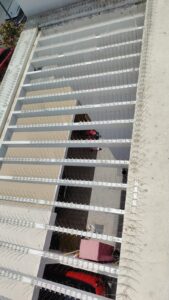
- Spikes stop birds landing on a surface. Use them for ledges, sills, signs, and rooftop edges.
- Bird wire makes a surface unstable to land on, with less visual impact than spikes. Use it for narrow ledges, pipes, and railings where looks matter.
Most persistent problems need more than one. The section on combinations covers that.
Start with the spot, not the product
| Where the birds are | Best first choice | Why |
|---|---|---|
| Open balcony or terrace | Balcony bird netting | Birds can’t enter, so nothing needs to be deterred |
| Narrow ledge or window sill | Bird spikes | Fits the exact width of the perch |
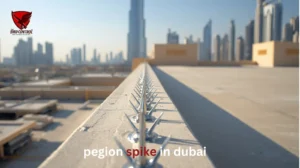
| Rooftop edge, signage, or beam | Bird spikes | A continuous line covers the whole perch |
| Railing, pipe, or thin ledge where looks matter | Bird wire | Nearly invisible from a distance |
| AC unit or ducting area | Netting or spikes, depending on access | Enclose it if birds nest inside, spike the top if they only perch |
| Large open space (courtyard, warehouse, atrium) | Bird netting | The only practical way to cover a big volume |
| Inside a building | Netting to close entry points | Stops re-entry after birds are removed |

Bird netting: best when the space is open
Netting is a physical barrier. Instead of making a spot unpleasant, it removes access to it. That makes it the most reliable option for enclosed areas, and the only sensible choice for large volumes.
Choose it when:
- Birds are entering a space, not just perching on it
- Several species are involved
- You need to protect furniture, equipment, or stock below
- Hygiene matters, such as around food, medical, or child-related areas
Watch out for:
- Installation quality decides everything. Gaps, loose fixings, or poor tension are how birds get in.
- The look changes slightly, so ask about mesh size and colour.
- Nets need occasional inspection, especially after storms or heavy dust.
Details on materials, sizes, and installation are on our bird netting page and our balcony netting page.

Bird spikes: best when the perch is narrow
Spikes stop birds landing on a specific surface. They work best on defined ledges and edges, and they need no ongoing maintenance beyond cleaning.
Choose them when:
- The problem is a defined ledge, sill, sign, or roof edge
- You need a permanent, low-maintenance fix
- The perch is narrow enough for a spike strip to cover fully
Watch out for:
- They protect the surface, not the space. Birds can still land beside them.
- Gaps in coverage give birds a foothold, so full-length installation matters.
- Nesting material can build up on poorly installed strips.
- A spike is only as good as its fixing. Material and mounting should suit the surface.
A note on “pigeon spikes”: this is not a separate technology. It is spike strips chosen with the right height and spacing for pigeon-sized birds. Smaller birds can need a tighter configuration. See our page on bird spikes or read the pigeon spikes guide for specifications.
Bird wire: best when appearance matters
Bird wire, sometimes called a tensioned wire system, uses thin wires held above a surface. Birds find it hard to balance, so they choose somewhere else. It is far less visible than spikes, which suits heritage-style facades, glass frontages, and premium buildings.
Choose it when:
- Visual impact is your main concern
- The surface is narrow, like a railing, pipe, or thin parapet
Watch out for:
- It has to be correctly tensioned to work
- It is a deterrent for perching, not a barrier for entry
See the bird wire system page for more.
Method comparison
| Netting | Spikes | Bird wire | |
|---|---|---|---|
| What it does | Blocks entry | Blocks landing | Makes landing unstable |
| Best for | Open spaces, balconies | Ledges, sills, edges | Railings, thin ledges |
| Coverage | Whole area | One surface | One surface |
| Visibility | Low to moderate | Low to moderate | Very low |
| Works against many species | Yes | Mostly for perching birds | Mostly for perching birds |
| Main risk | Poor installation leaves gaps | Gaps in coverage | Wrong tension or spacing |
When one method isn’t enough
Birds look for the easiest option. If you block one spot, they may move to the next. A combined plan usually works better:
- Apartment balcony: net the balcony, and spike or wire the outer ledge and AC unit top so birds don’t simply move next door.
- Commercial building: spikes or wire along façades and signage, netting for loading areas, terraces, and recessed spaces.
- Restaurant or hotel: netting around dining terraces and food-handling areas, deterrents on outside ledges.
If you are also considering non-physical options, read our overview of bird repellent options, our bird deterrent systems guide, and electronic bird deterrents. Physical barriers are usually the more permanent choice, while deterrent devices are often used as a supporting layer.
Common mistakes
- Choosing by price instead of by spot. A cheaper product in the wrong place means paying twice.
- Treating one perch and ignoring the next. Birds relocate to the nearest untreated surface.
- Leaving a nest or droppings in place. Clean and clear the area before installation.
- Poor fixing or tension. Installation quality, more than the product, decides how long a fix lasts.
- Skipping an inspection. Different buildings, floors, and orientations create different bird behaviour.
How to decide in five minutes
- Where exactly do birds land or nest? List each spot.
- Is the spot a space (they enter it) or a surface (they perch on it)?
- Spaces → netting. Surfaces → spikes or wire.
- Does appearance matter? If yes, ask about wire or clear netting.
- Are there nearby surfaces they could move to? If yes, plan for a combined solution.
A professional inspection turns this into a written plan. Our bird control services start with a site assessment, and you can read more about our team.
FAQs
Which is better, bird netting or bird spikes? Neither is better everywhere. Netting suits spaces birds enter, such as balconies and terraces. Spikes suit surfaces birds perch on, such as ledges and sills. Many properties need both.
Are pigeon spikes different from bird spikes? Not fundamentally. “Pigeon spikes” usually means spike strips with spacing and height suited to pigeons. The installation and principle are the same.
Is bird wire better than spikes? It is less visible, so it suits premium or visually sensitive surfaces. Spikes are more visible, and they suit wider ledges. The better option depends on the surface.
Are these methods humane? Netting, spikes, and wire are designed to deter or block birds without harming them. Correct installation matters, so nets and wires don’t create gaps where birds get trapped.
Can I install these myself? Simple products can be fitted at home, but height, fixings, and coverage gaps are the common causes of failure. Working at height on high-rise buildings should be left to trained installers.
Should I combine methods? Often, yes. If birds have several perches nearby, blocking only one usually moves the problem elsewhere.
Conclusion
Choose by the spot: netting for spaces, spikes or wire for surfaces, and a combined plan when birds have alternatives nearby. Get the spot list right, and the method usually becomes obvious.