If you’ve noticed pigeons taking over your balcony, rooftop, or AC unit, you’ve probably considered bird spikes as a solution. But before installing them, one question comes up again and again, especially from animal lovers and concerned homeowners: do bird spikes hurt birds?
The short answer is no. Bird spikes are designed to be a safe, humane deterrent — not a weapon. They don’t injure, trap, or kill birds. They simply make landing uncomfortable enough that birds choose to perch somewhere else.
This is one of the most searched questions in bird control, and for good reason. Nobody wants to solve a pigeon problem by causing harm to wildlife. In this guide, we’ll explain exactly how bird spikes work, why they’re considered one of the most humane bird control methods available, what the science and industry standards actually say, and what separates a properly installed system from a poorly placed one that could cause issues.
Why People Worry About Bird Spikes in the First Place
The word “spike” naturally sounds aggressive. Visually, a strip of pointed rods can look intimidating, especially to someone who has never seen how birds actually interact with them. This is the main reason the question “do bird spikes hurt birds” trends so highly in search results — the name doesn’t match the reality.
There’s also been media coverage over the years of badly installed or counterfeit spike products causing harm, which understandably raises concern. Add to that the fact that some property owners install spikes themselves without understanding bird behavior, and it’s easy to see why misconceptions spread.
The good news: when you separate the product from poor installation practices, the picture becomes much clearer. Properly designed and professionally installed bird spikes are one of the most studied, widely approved, and genuinely humane bird deterrents on the market.
How Bird Spikes Actually Work
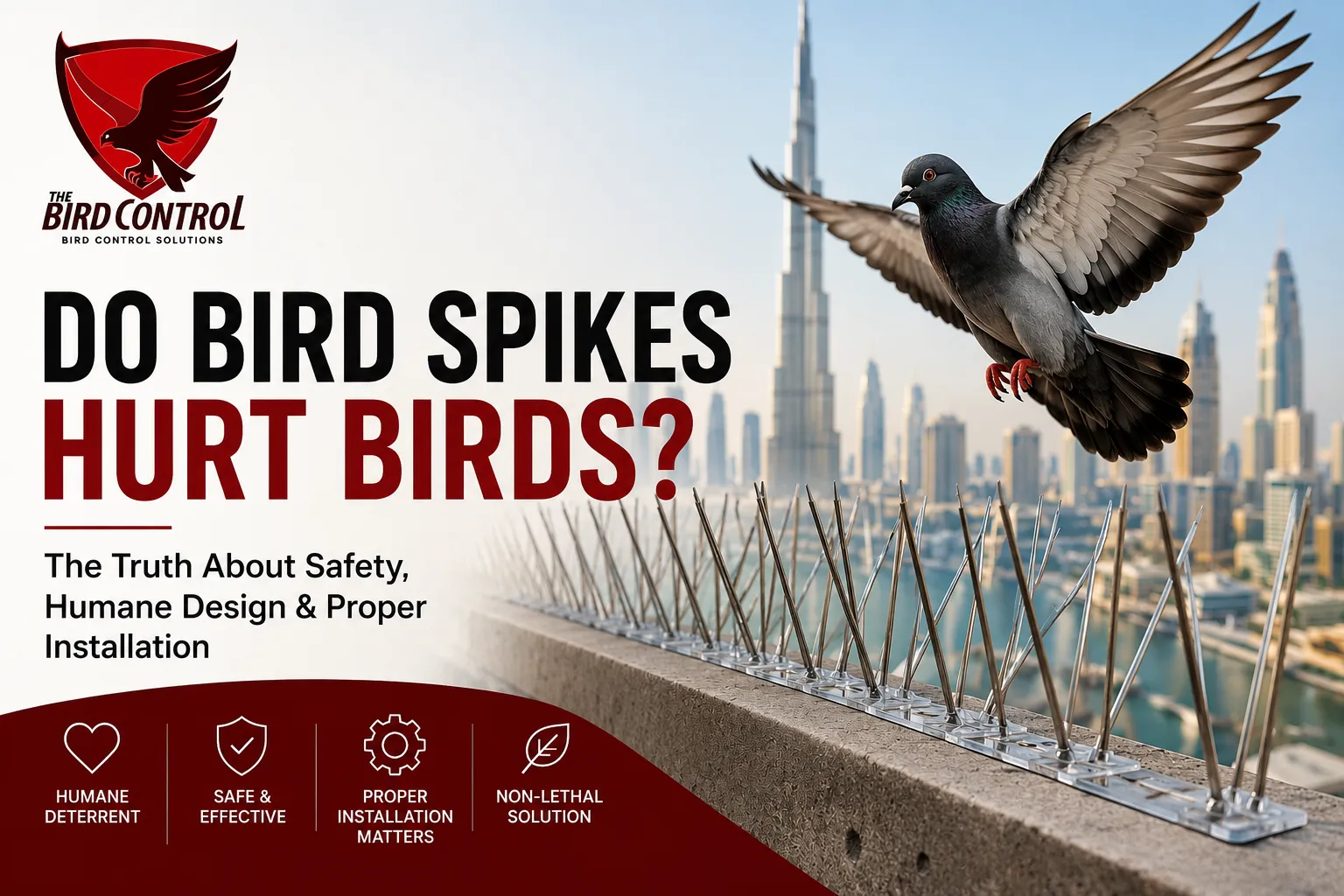
Bird spikes are strips of blunt-tipped rods — usually made from stainless steel or UV-resistant polycarbonate plastic — fixed to ledges, rooftops, signage, parapets, and other surfaces where birds like to land.
The spikes don’t pierce, stab, or trap birds. Instead, they work through simple physics and bird behavior:
- They create an uneven, unstable surface that birds can’t comfortably grip with their feet
- They make it physically difficult for a bird to fold its wings and settle into a resting position
- They remove the flat landing zone birds rely on to balance, rest, and preen
- They encourage birds to fly to a different, more suitable perch nearby instead
Pigeons, sparrows, and crows have sensitive feet and rely on a flat, stable surface to land safely and comfortably. A field of evenly spaced spikes removes that option entirely — without the bird ever being struck, gripped, or trapped by anything.
It’s worth noting that birds are highly capable fliers with excellent depth perception. They see the spikes from a distance and simply choose not to land, the same way a person wouldn’t choose to sit down on a row of upright nails. The deterrent works before the bird ever gets close enough for contact to be a factor.
Why Bird Spikes Are Considered Humane
Professional bird control in Dubai relies on bird spikes precisely because they avoid harm while still solving the underlying problem. Here’s why they’re classified as a humane deterrent by pest control authorities, architects, and wildlife organizations alike:
No physical contact. Birds simply avoid landing in the first place — they never make contact with the spikes in a way that causes injury. The deterrent effect happens visually and behaviorally, before any physical interaction occurs.
No poison, no trapping. Unlike chemical repellents, glue traps, or live capture methods, spikes don’t involve killing, injuring, or removing birds from their environment. The bird remains completely free to fly anywhere it chooses.
Behavioral, not physical. The goal is to change where a bird lands, not to harm the bird itself. This is the same underlying principle behind bird netting and bird wire systems — both are physical barriers designed to redirect bird behavior, not to cause physical harm.
Reversible and non-lethal. If a property owner ever wants to remove a bird spike installation, doing so causes no lasting harm to local bird populations. Compare this to lethal methods like poisoned bait, which can have long-term ecological consequences far beyond the original problem.
Used by architects and regulators worldwide. Bird spikes are widely specified by architects, facility managers, heritage building conservators, and pest control authorities specifically because they meet humane wildlife deterrent standards. They’re commonly approved for use on historic buildings, monuments, hospitals, and even airports — environments where harming wildlife would never be acceptable.
Supported by animal welfare logic, not just industry claims. The core principle — denying a comfortable landing surface rather than attacking the animal — is the same logic used in many humane wildlife management strategies, from deer-proof fencing to motion-activated deterrents.
When Bird Spikes Can Cause Problems
Bird spikes are safe — but only when installed correctly. Most concerns about birds getting hurt come from poor installation or low-quality materials, not the product concept itself. Common mistakes include:
Incomplete coverage. Leaving small gaps between spike strips creates awkward, half-protected surfaces where a determined bird might try to squeeze in and get a foot caught between sections.
Incorrect spacing for the bird species. Spike spacing designed for large pigeons may not properly deter smaller birds like sparrows, who can sometimes find narrow gaps between rows. Professional installers adjust spacing based on the specific species causing the problem.
Low-quality or counterfeit materials. Cheap, poorly manufactured plastic spikes can become brittle in heat, bend out of shape, or develop sharp broken edges over time — very different from the smooth, blunt-tipped design of certified products.
DIY installation without understanding bird behavior. Without professional assessment, property owners sometimes install spikes at the wrong angle, on the wrong surfaces, or with insufficient anchoring, reducing both safety and effectiveness.
Improper angle or excessive elevation. Spikes that are angled too aggressively or installed without considering wind exposure can shift out of position over time, creating uneven surfaces that don’t function as intended.
This is exactly why professional installation matters so much. At The Bird Control Dubai, our trained technicians assess your property, identify the bird species involved, choose the correct spike spacing and material, and ensure complete, secure coverage — so the system works exactly as intended, safely and effectively, from day one.
What Happens to Birds After Spikes Are Installed?
A common follow-up question is: where do the birds go once they can no longer land on your property? The answer is simple — they relocate to a different, unobstructed perch nearby. Birds are highly adaptable and will naturally seek out alternative ledges, trees, or rooftops in the surrounding area.
This is an important distinction from lethal control methods. Bird spikes don’t reduce bird populations, harm individual birds, or disrupt nesting elsewhere — they simply redirect where birds choose to land on your specific property. For business owners and homeowners who want a bird-free space without affecting local wildlife, this makes spikes one of the most ethically sound options available.
Bird Spikes vs. Other Bird Control Methods
| Method | Humane? | Notes |
|---|---|---|
| Bird spikes | Yes | No contact, no harm, long-lasting, reversible |
| Bird netting | Yes | Full exclusion barrier, doesn’t touch birds |
| Bird wire systems | Yes | Creates unstable landing, nearly invisible |
| Bird repellent gel | Generally yes | Discomfort-based, though some birds may get sticky residue on feathers if over-applied |
| Sound/ultrasonic deterrents | Yes | No contact, though effectiveness varies and birds can habituate |
| Poison or toxic gels | No | Can cause illness or death; not recommended or commonly licensed |
| Glue traps | No | Can trap and injure birds; widely discouraged by welfare organizations |
| Electrified tracks | Disputed | Causes a mild shock; raises ethical concerns for some property owners |
| Live trapping/removal | Mixed | Doesn’t harm the bird directly, but is stressful and doesn’t solve the recurring issue |
If your priority is a humane, long-term solution that doesn’t involve any physical harm to birds, bird spikes remain one of the safest and most effective choices available for Dubai properties, alongside netting and wire systems.
How to Make Sure Your Bird Spike Installation Is Safe
If you’re considering bird spikes for your property, here’s what to look for to ensure the system is both effective and completely safe for birds:
- Choose certified, high-quality materials. Stainless steel or UV-stabilized polycarbonate with blunt, rounded tips — not sharp or brittle plastic.
- Insist on a proper site assessment. A professional should identify which bird species are involved before recommending spacing and placement.
- Avoid gaps in coverage. Spike strips should be continuous across ledges, with no awkward half-protected sections.
- Check the warranty and workmanship guarantee. Reputable installers stand behind their work, which is a good sign the installation meets safety and quality standards.
- Ask about maintenance. Spikes should be checked periodically to ensure they haven’t loosened, bent, or shifted out of position over time.
Frequently Asked Questions
Do bird spikes kill birds? No. Bird spikes are blunt-tipped and designed only to prevent landing — they don’t injure or kill birds in any way. They work by removing a comfortable landing surface, not by causing physical harm.
Can a bird get stuck on bird spikes? This is rare and almost always linked to poor-quality materials, incorrect spacing, or incomplete coverage. Professionally installed, properly spaced spikes prevent this entirely by giving birds no reason or opportunity to attempt landing.
Are bird spikes cruel? No. Wildlife and pest control authorities classify bird spikes as a humane deterrent because they work through discomfort and behavior change, not physical harm. They’re widely approved for use on hospitals, heritage buildings, and public infrastructure.
Do bird spikes work on all bird species? Yes, with the right spacing. Pigeons, sparrows, crows, and seagulls all respond to properly configured spike systems — spacing is simply adjusted based on the size and behavior of the species involved.
Is professional installation necessary for bird spikes to be safe? Yes. Improper spacing, low-quality materials, or incomplete coverage are the leading causes of any safety concerns. Professional installation ensures spikes are both effective and completely safe for birds from the very first day.
Where do birds go after spikes are installed? Birds simply relocate to a nearby, unobstructed perch. Spikes don’t harm or reduce bird populations — they only redirect where birds land on your specific property.
How long do bird spikes last, and do they need maintenance? Stainless steel spikes can last well over a decade, while plastic versions typically last several years. Periodic inspection ensures spacing remains intact and no sections have shifted, bent, or loosened.
The Bottom Line
Bird spikes don’t hurt birds — they simply make your property an unappealing place to land. The concept relies entirely on behavior and discomfort, not physical contact or injury, which is why it’s recognized as one of the most humane bird deterrent methods available worldwide.
The only real risk comes from poor-quality materials or incorrect installation — both of which are easily avoided with a professional assessment and certified products. When installed by trained technicians with the right materials and spacing, bird spikes offer a long-lasting, completely humane way to keep pigeons and other birds off your balcony, rooftop, or building ledge — without a single bird ever being harmed.
Ready for a bird-free property without harming a single bird? Contact The Bird Control Dubai for a free inspection and a customized, humane bird spike installation plan tailored to your property and the bird species you’re dealing with.