Introduction
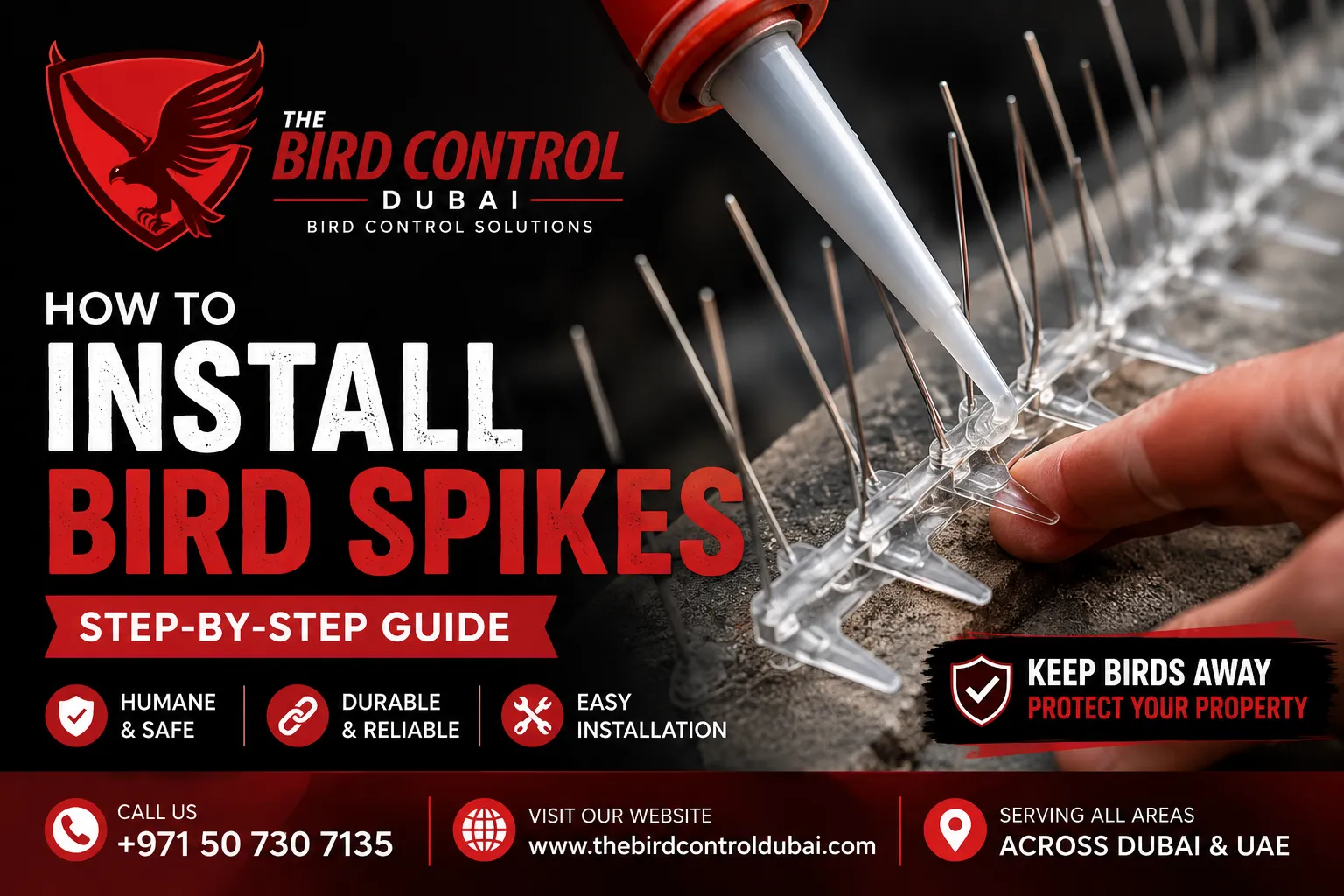
Bird spikes are one of the most effective solutions for keeping pigeons and other unwanted birds away from your property. Unlike temporary deterrents, properly installed bird spikes provide years of reliable protection without maintenance or ongoing costs. However, installation quality directly impacts how well they work.
This guide covers everything you need to know about how to install bird spikes — from preparation to final inspection. Whether you’re considering a DIY approach or deciding if professional bird spike installation makes sense for your situation, you’ll understand exactly what’s involved.
Key fact: Improper bird spike installation is the #1 reason bird spike systems fail. Small gaps, weak anchoring, or poor angle placement mean birds can still find landing spots. That’s why many Dubai property owners choose professional installation after learning what’s involved.
What You’ll Need: Tools and Materials
Essential Tools
Before starting any bird spike installation project, gather these tools:
- Drill with bits (for concrete, wood, or metal surfaces)
- Measuring tape (at least 5 meters)
- Level (to ensure proper spike angle — critical for effectiveness)
- Chalk line or pencil (for marking bird spike installation points)
- Screwdriver set (both Phillips and flathead)
- Hammer or mallet (for tap-on anchors)
- Ladder or scaffolding (safe access to high areas)
- Safety harness (for work at height — essential in Dubai where buildings are tall)
- Work gloves (cuts and sharp edges are common)
- Safety glasses (debris protection)
- Caulk gun (for sealant application)
Required Materials
The materials you’ll need depend on your surface type:
For all spike installations:
- Bird spike strips (appropriate length for your perimeter)
- Bird spike fastening hardware (screws, anchors, or adhesive — varies by surface)
- Waterproof sealant or silicone
- Mounting brackets (if needed for your spike system)
For concrete surfaces:
- Concrete anchors (wedge anchors or expansion bolts)
- Pre-drill bits sized for your anchors
For metal surfaces:
- Self-tapping screws or rivet nuts
- Washers (to distribute load)
For wood surfaces:
- Wood screws (stainless steel preferred for UAE climate)
- Wooden shims (for leveling)
For plastic or composite materials:
- Low-profile adhesive clips or brackets
- Construction-grade adhesive (for surfaces where screwing isn’t suitable)
Step 1: Inspect and Prepare Your Surface
Survey the Area
Before buying bird spikes or tools, inspect where birds currently perch and nest:
- Rooflines and gutters — check for nesting debris, droppings, or feather buildup
- Ledges and balconies — identify roosting spots
- AC units and vents — often prime bird landing zones
- Architectural features — decorative ledges attract birds
- Building corners and peaks — exposed edges where birds congregate
Mark these areas with chalk or tape. Measure the total linear footage you’ll need to cover.
Clean Thoroughly
Bird droppings and debris reduce adhesion and bird spike fastening security. Clean all surfaces:
- Remove loose debris by hand
- Pressure wash surfaces (use low pressure on delicate areas)
- Allow surfaces to dry completely (at least 24 hours in Dubai’s climate)
- For metal surfaces, use a wire brush to remove rust or oxidation
- For concrete, use a degreaser if oil staining is present
Why this matters: Even thin layers of pigeon dropping residue can prevent adhesive from bonding properly. In Dubai’s heat and humidity, moisture trapped under improperly cleaned bird spikes leads to rust and fastener failure.
Test Surface Integrity
- For concrete: Check for cracks or spalling (deteriorated areas). Bird spikes installed on weak concrete will fail when birds land on them
- For wood: Probe for rot with a screwdriver — soft spots indicate decay
- For metal: Look for rust pits (severe corrosion means the surface won’t hold bird spike fasteners securely)
- For existing spike systems: If replacing old bird spikes, inspect for damage from weathering or poor installation
Step 2: Measure and Mark Installation Points
Determine Spike Spacing
Proper spacing is critical — too far apart and birds find gaps; too close and you waste material and money.
Standard spacing guidelines:
- For pigeons: 10–15 cm (4–6 inches) apart
- For smaller birds (sparrows, starlings): 7–10 cm (3–4 inches) apart
- For mixed bird species: Use 8–10 cm (3–4 inches) spacing for coverage
Create Reference Lines
Using a chalk line or pencil, mark:
- Center line along your bird spike installation surface (helps maintain straight runs)
- Mounting holes at your chosen spacing intervals
- Distance from edges (typically 2–3 cm from the surface edge where bird spikes will attach)
Pro tip: For balconies and railings, mark mounting points on both sides if birds approach from multiple angles. For rooflines, mark the outer edge plus 5–10 cm inward — bird spikes should protect the landing zone, not just the very edge.
Account for Obstacles
Mark areas where you’ll need to stop and restart (where air vents, pipes, or architectural features interrupt the line). Plan how bird spikes will transition around these obstacles.
Step 3: Prepare Fastening Points
Drilling for Concrete
Concrete requires the most preparation for bird spike installation:
- Use the correct bit size — match your anchor specifications (typically 6–10mm for standard bird spike anchors)
- Drill depth — holes should be 5–10mm deeper than your anchor length
- Drill slowly — high-speed drilling in concrete causes cracking; use a hammer drill on low speed
- Clean holes — blow out dust with compressed air (never use water — it weakens the concrete-anchor bond)
- Insert anchors — place expansion bolts or wedge anchors in holes before mounting bird spike strips
Common concrete drilling mistakes:
- Drilling too fast (cracks the concrete)
- Not cleaning holes (dust prevents anchor seating)
- Using insufficient anchor depth (bird spikes pull away under stress)
- Installing in cracked or spalling concrete (anchors won’t hold)
Preparing Metal Surfaces
Metal is faster but requires the right fasteners for bird spike installation:
- Clear rust or paint — use a wire brush where bird spikes will mount
- Use self-tapping screws or pre-drill pilot holes (prevents metal splitting)
- Add washers — distributes load and prevents screw heads from pulling through
- Check for sufficient thickness — metal must be at least 3mm thick to hold bird spike fasteners securely
- For hollow metal — use rivnuts or drill-through fastening rather than self-tapping screws
Preparing Wood Surfaces
- Remove old paint or sealant in mounting areas (rough surface = better bird spike fastening)
- Verify wood is solid — soft wood won’t hold bird spikes
- Pre-drill holes — prevents wood splitting around fasteners
- Use corrosion-resistant screws — stainless steel or galvanized (critical in UAE climate where salt air corrodes standard screws)
Adhesive Application (Alternative Method)
Some bird spike systems use construction adhesive instead of fasteners:
- Choose appropriate adhesive — must be rated for outdoor use and the specific surface
- Clean adhesive residue — old adhesive prevents new adhesive bonding
- Prime if recommended — some adhesives require primer on porous surfaces
- Apply in strips — 2–3 beads along the mounting base of the bird spike strip
- Allow full cure time — typically 24–48 hours before subject to weight
When adhesive works best: Smooth, flat surfaces (like aluminum window sills) where drilling is difficult. Where adhesive fails: Porous concrete, weathered wood, or anywhere water can get behind the adhesive.
Step 4: Install the Spike Strips
Positioning for Effectiveness
This step determines whether bird spikes actually stop birds from landing:
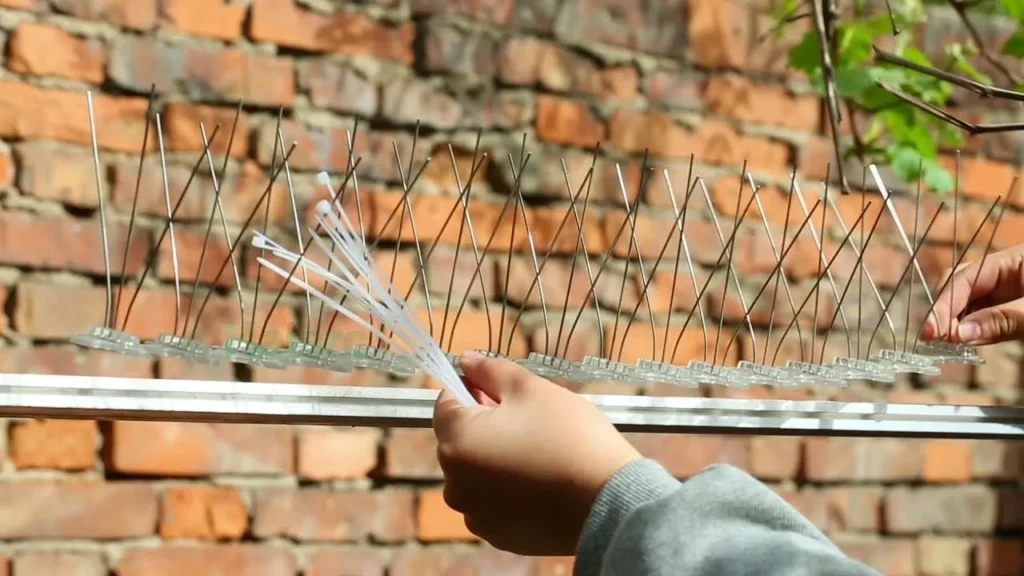
- Angle matters — bird spikes should angle slightly upward (15–20 degrees) from horizontal. Birds can sometimes land on perfectly horizontal spikes
- Height placement — position the base strip right at the edge of the landing surface. Bird spikes set back 5+ cm from the edge leave a landing zone
- Coverage — bird spikes must extend the full length of potential landing areas. A 1-meter gap in a 10-meter roofline gives birds a perfect perch
Fastening Process
For screw-mounted systems:
- Line up the first bird spike strip at your marked position
- Use your level to ensure proper angle (slightly upward is better than flat)
- Insert the first fastener but don’t tighten fully yet
- Check alignment with your chalk line
- Insert remaining fasteners for that strip
- Tighten fasteners in a cross pattern (this distributes stress evenly)
- Test for movement — the strip shouldn’t move when you apply reasonable pressure
For anchor-mounted systems:
- Insert the pre-positioned anchors fully
- Lower the bird spike strip into position
- Insert bolts or fasteners through the strip into the anchors
- Tighten progressively along the strip length
- Final tightening should be firm but not over-tightened (can strip threads or crack plastic bird spikes)
For adhesive systems:
- Apply adhesive beads along the mounting surface
- Press the bird spike strip firmly into position
- Use your level to verify angle
- Hold or clamp for the time specified by your adhesive (usually 2–5 minutes)
- Do not subject to weight or stress until fully cured
Working with Corners and Transitions
- Inside corners — cut bird spike strips at 45-degree angles so they meet seamlessly
- Outside corners — install strips to the corner edge, then start a new strip on the perpendicular surface
- Where bird spikes meet obstacles — trim spike strips to fit around vents or pipes, ensuring no gaps where birds can land
Step 5: Seal and Waterproof
Why Sealing Matters
In Dubai’s humid climate, water penetration under bird spike strips causes:
- Rust on bird spike fasteners
- Concrete weakening around anchors
- Moisture damage to underlying surfaces
- Fastener corrosion that leads to bird spikes pulling away
Sealing Process
- Apply waterproof sealant along the base of the bird spike strip where it meets the surface
- Use a caulk gun for clean, even application
- Select appropriate sealant — polyurethane or silicone rated for outdoor use
- Apply generously — sealant should fill the gap completely
- Smooth the bead — use a wet finger or caulking tool for a neat appearance
- Allow full cure time — typically 24–48 hours before exposure to water
Areas That Need Extra Attention
- Roof edges and gutters — water flows here constantly
- Balcony ledges — exposed to rain and dust
- AC unit tops — condensation drips from units
- Any junction where water could pool — seal thoroughly
Step 6: Final Inspection and Testing
Check Installation Quality
Visual inspection:
- Are bird spikes at consistent height along the full run?
- Do bird spikes angle slightly upward (not flat or downward)?
- Are there any gaps larger than a bird’s foot width?
- Is sealant applied consistently?
- Are bird spike fasteners tight and not protruding?
Physical testing:
- Grasp the bird spike strip and try to move it side to side — it should be immobile
- Check for loose bird spike fasteners by hand (tighten any that have shifted)
- Look for gaps between the bird spike base and mounting surface
- Verify that all anchors are fully seated in concrete
Problem spots to address:
- Loose bird spike fasteners — tighten immediately
- Gaps at mounting points — apply additional sealant
- Bird spikes at wrong angle — remove and reinstall if severity is significant
- Uneven height — mark for professional remediation if DIY correction isn’t feasible
Test Under Load (Carefully)
Gently press on installed bird spikes to verify they don’t deflect excessively. Slight flex (1–2mm) is normal, but bird spikes shouldn’t move significantly under hand pressure.
Step 7: Common Bird Spike Installation Mistakes to Avoid
Mistake #1: Insufficient Fastening
What happens: Bird spikes loosen after weeks or months, creating movement that birds exploit. Why it occurs: Under-tightening bird spike fasteners, using wrong fastener size, or poor surface preparation. Result: Bird spikes that look good initially fail within months, requiring expensive replacement.
Mistake #2: Spacing Too Wide
What happens: Birds find gaps and land between bird spike strips. Why it occurs: Using wider spacing to save money or time. Result: Birds still land and nest, rendering bird spikes ineffective. Most bird landing surfaces are only 5–10cm wide — gaps larger than 10cm invite problems.
Mistake #3: Improper Height or Angle
What happens: Bird spikes too low or flat don’t effectively block landing; birds perch anyway. Why it occurs: Misunderstanding bird spike design or rushing bird spike installation. Result: The most frustrating failure — bird spikes installed but birds still landing. This is why professional installers know to position bird spikes slightly elevated at the landing edge.
Mistake #4: Inadequate Surface Preparation
What happens: Bird spike fasteners pull free or adhesive fails prematurely. Why it occurs: Skipping the cleaning step, especially on concrete with droppings. Result: Expensive replacement after 6–12 months instead of 5–10 years of protection.
Mistake #5: Ignoring Roof Access Safety
What happens: Falls or injuries during bird spike installation. Why it occurs: Working at height without proper safety equipment. Result: Why many property owners opt for professional bird spike installation — the safety risk isn’t worth the savings.
Mistake #6: Installing in the Wrong Locations
What happens: Bird spikes installed where birds don’t actually land. Why it occurs: Not observing bird behavior or not identifying all problem areas before bird spike installation. Result: Wasted effort and materials on areas that didn’t need protection while actual problem areas remain unprotected.
When Professional Bird Spike Installation Makes Sense
After reviewing the bird spike installation process, here’s when hiring professionals is the smarter choice:
High-Risk Situations
- Work at significant height (above 2 stories) — safety equipment and training are essential
- Complex roof structures — multiple angles, valleys, and obstacles complicate bird spike installation
- Architectural features — historic or unusual designs require expertise
- Building regulations — some Dubai bird spike projects have HOA or building code restrictions requiring professional installation
Difficult Surfaces
- Deteriorated concrete — requires assessment before bird spikes can be secured
- Corroded metal — improper work shortens bird spike lifespan
- Sloped or curved surfaces — requires custom angle planning and bird spike adaptation
Quality and Warranty Considerations
Professional bird spike installation provides:
- Warranty coverage — if bird spikes fail due to installation, it’s covered
- Ongoing support — annual inspections catch problems early
- Proper tools and safety equipment — not a one-time purchase cost
- Years of experience — knowing which techniques work in Dubai’s bird spike installation climate
Our experience: We’ve inspected hundreds of DIY bird spike installations in Dubai. Many fail within 12–24 months due to inadequate bird spike fastening in heat-stressed concrete or improper angle placement. Professional bird spike installation typically lasts 5–10 years without issues.
Bird Spikes vs. Other Control Methods
Bird Spikes vs. Bird Netting
Bird spikes work best for:
- Ledges, railings, and rooflines
- Areas where aesthetics matter (nearly invisible once installed)
- Long-term pigeon control without maintenance
Bird netting works best for:
- Complete area exclusion (balconies, courtyards)
- Larger protected zones
- Situations where bird spikes can’t be positioned effectively
Bird Spikes vs. Wire Systems
Bird spikes provide:
- Permanent landing prevention
- Single bird spike installation cost
- Minimal maintenance
Bird wire systems provide:
- Nearly invisible protection
- Better for decorative structures
- Lower visual impact on modern buildings
For most Dubai properties, bird spikes are the most cost-effective solution for rooflines, gutters, and ledges. They’re simple enough for many property owners to install bird spikes themselves, though professional bird spike installation ensures they work as intended.
Dubai-Specific Considerations for Bird Spike Installation
Heat and Material Durability
Dubai’s extreme temperatures affect bird spike performance:
Temperature effects:
- Plastic bird spikes become brittle after 3–5 years under intense UV exposure
- Bird spike fasteners in concrete expand and contract seasonally, potentially loosening over time
- Adhesive can fail in extreme heat if not rated for Dubai bird spike installation conditions
Best practices:
- Choose stainless steel bird spikes over plastic (they last 15–20 years vs. 5–10 years)
- Use heat-resistant sealant (standard caulk fails in 50°C+ temperatures)
- Inspect bird spike fasteners annually; Dubai’s expansion/contraction cycle can loosen them
Sandstorms and Dust
Dubai’s frequent sandstorms introduce challenges for bird spike installation:
- Dust accumulation can hide issues with bird spike fastening security
- Sand particles in sealant reduce waterproofing effectiveness
- Annual cleaning and inspection of bird spikes is especially important
Building Code Compliance
- HOA approval may be required before bird spike installation
- Some historic or prestigious buildings have aesthetics guidelines
- Palm Jumeirah and other planned communities often have restrictions
Check your building requirements before starting bird spike installation. Professional bird spike installers are familiar with community guidelines and can advise on compliance.
Maintenance After Bird Spike Installation
Bird spikes require minimal maintenance, but some care extends their lifespan:
Annual Tasks
- Visual inspection — walk the entire bird spike installation annually
- Tighten bird spike fasteners — Dubai’s heat causes slight movement; annual tightening prevents loosening
- Clear debris — remove leaves, dust, and nesting material that collects on bird spikes
- Check sealant — look for cracks or separation; re-seal if needed
Every 2–3 Years
- Deep clean — remove bird droppings and debris buildup from bird spikes
- Inspect for rust — small rust spots on bird spike fasteners should be cleaned and re-sealed
- Check for damage — verify no bird spikes are bent or missing
Every 5 Years (Stainless Steel) or 3 Years (Plastic)
- Professional bird spike inspection — a trained eye catches problems DIY maintenance misses
- Sealant replacement — original sealant may be degrading
- Photo documentation — track bird spike condition over time
Frequently Asked Questions About Bird Spike Installation
Q: Can I install bird spikes myself, or should I hire professionals?
A: You can install bird spikes yourself if you’re comfortable working at height and have basic tools. However, improper bird spike installation is the #1 cause of spike failure. Many Dubai property owners discover after installing bird spikes that spacing was wrong, angles were incorrect, or bird spike fasteners loosen in the heat. If your project involves roofwork or complex areas, professional bird spike installation is worth the investment.
Q: How long do bird spikes last in Dubai’s climate?
A: Quality stainless steel bird spikes last 15–20 years. Plastic bird spikes typically last 5–10 years before UV exposure makes them brittle. In Dubai specifically, choose stainless steel bird spikes if you want long-term pigeon control without replacement costs. Bird spike fastener and sealant quality also affect longevity — professional bird spike installations use Dubai-rated materials designed for extreme heat.
Q: Will bird spikes damage my roof or balcony?
A: No, when installed correctly. Bird spikes attach to surfaces without penetrating deeply. For concrete, holes are shallow anchoring points. For metal, screws are placed to avoid stress points. The bird spike fastening method is similar to securing a handrail. However, if your roof or balcony has underlying damage, bird spike installation can sometimes reveal problems (like soft concrete where bird spike anchors won’t hold).
Q: Do birds get hurt by bird spikes?
A: No. Bird spikes have blunt or flexible tips that make landing uncomfortable, not painful or injurious. Birds simply recognise that landing there is difficult and choose elsewhere. This is why bird spikes are considered humane — they deter without harming.
Q: What’s the best spacing for bird spike installation?
A: For pigeons and common urban birds, 10–15cm spacing is standard. For smaller birds like sparrows, 7–10cm spacing provides better bird spike installation coverage. The goal is spacing small enough that birds can’t fit between bird spikes comfortably.
Q: Can I install bird spikes over existing spikes?
A: Sometimes, but it’s not recommended. Old bird spikes may be loose or damaged, making them an unstable base. It’s better to remove old bird spikes, inspect the surface, and install bird spikes fresh with proper bird spike fastening. If you’re adding bird spikes to an area not previously protected, ensure the new bird spike installation is independent and properly fastened.
Q: How much does bird spike installation cost?
A: DIY material costs typically range from AED 50–200 per meter depending on bird spike type and local suppliers. Professional bird spike installation costs AED 150–400 per meter depending on surface difficulty and accessibility. Professional bird spike installation includes labor, tools, safety equipment, and warranty — often worth the premium given the difference between successful and failed bird spike installations.
When to Call Bird Spike Installation Professionals
After reading this guide, you understand what bird spike installation involves. If your situation includes any of these factors, professional bird spike installation is recommended:
✓ Work required at height above 2 stories ✓ Complex roof structures with multiple angles ✓ Large areas requiring 50+ meters of bird spikes ✓ Deteriorated concrete or corroded metal surfaces ✓ Architectural or historic building concerns ✓ Building restrictions or HOA approval required ✓ Preference for warranty coverage and ongoing support
The Bird Control Dubai Professional Approach
At The Bird Control Dubai, we’ve completed bird spike installation on thousands of Dubai properties. Our bird spike installation process includes:
- Free property inspection to identify all bird spike installation problem areas
- Custom bird spike solution design for your specific bird problems and surface types
- Professional bird spike installation using Dubai-rated materials and proven techniques
- Quality inspection before handover
- Warranty coverage on bird spike materials and workmanship
- Annual maintenance program to ensure bird spikes remain effective
Most clients tell us that after researching how to install bird spikes themselves, they realise the time, tools, and safety risks make professional bird spike installation the smarter choice.
Conclusion
Bird spike installation is manageable for property owners with basic DIY skills and access to proper tools. However, Dubai’s specific challenges — extreme heat, humidity, dust, and complex building designs — make professional bird spike installation the preferred choice for most properties.
Whether you choose to install bird spikes yourself or hire professionals, understanding the process ensures you’ll recognise quality work and can evaluate whether your bird spike installation will actually stop birds from landing.
The most important principle: Proper bird spike installation determines whether bird spikes work. Bird spikes installed too far apart, at the wrong angle, or with loose bird spike fasteners fail to protect your property. An extra month of planning or investment in professional bird spike installation pays off with years of effective, maintenance-free pigeon control.
Ready to solve your bird problems? Schedule a free property inspection with The Bird Control Dubai. We’ll assess your specific situation and recommend whether DIY or professional bird spike installation is best for your property.