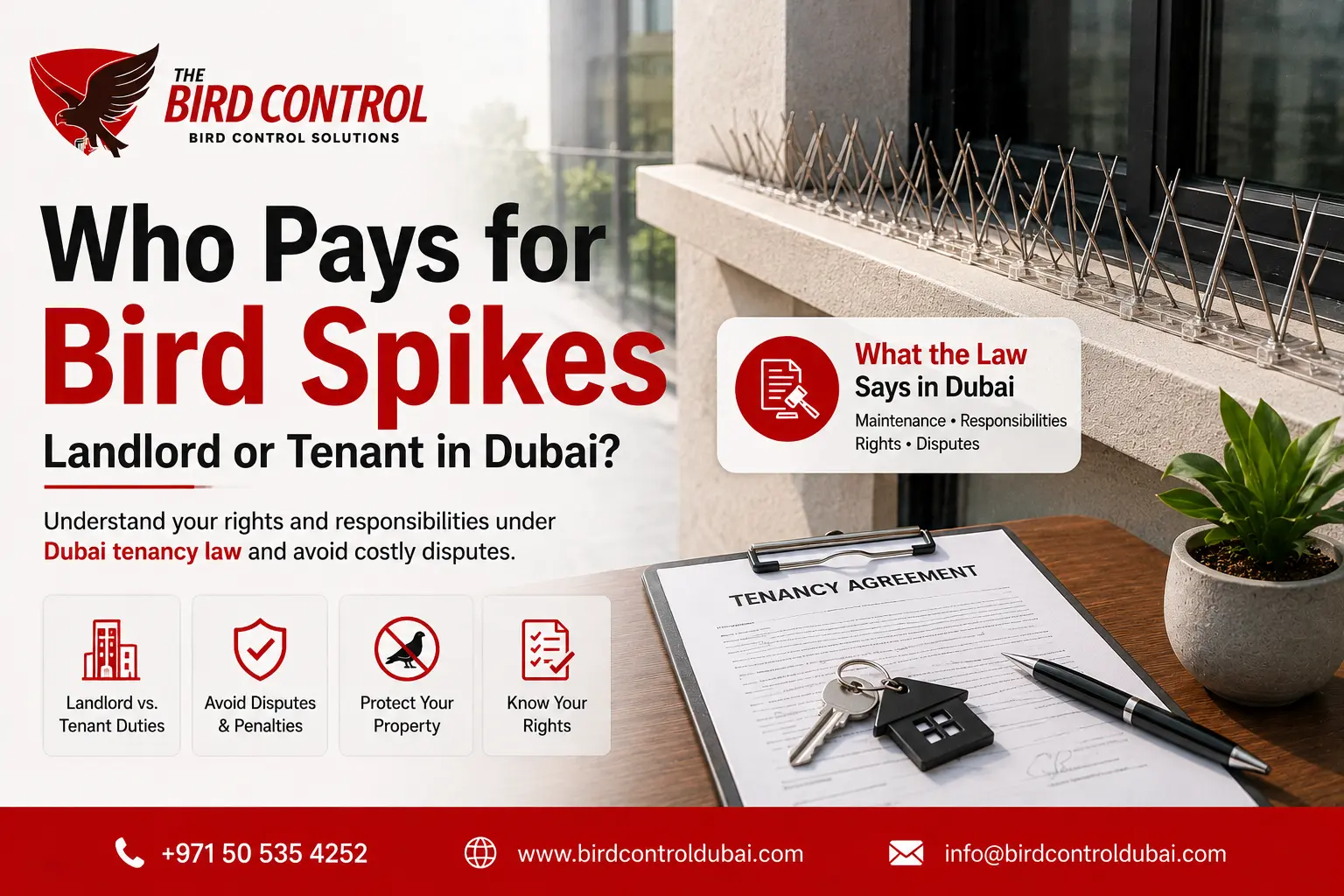
You've spotted pigeons roosting on the ledge again. Droppings are building up on the balcony floor, the noise starts before sunrise, and you've decided it's time for bird spikes. But before anyone picks up a drill or calls a contractor, there's a question that catches almost every renter and property owner in Dubai off guard: who actually pays for it?
It's a fair thing to get stuck on. Bird spikes get fixed permanently to the building — the ledge, the parapet wall, the AC unit, the balcony railing — which makes them feel more like a structural repair than a personal purchase. And in a city where tenancy disputes are settled through RERA's Rental Dispute Settlement Centre, getting this wrong can turn a straightforward pest problem into a drawn-out argument over a security deposit.
Here's the short answer, then we'll walk through exactly how Dubai tenancy law treats it, and what to check before anyone spends a single dirham.
In most Dubai tenancies, the landlord pays for bird spikes, because pigeon and pest problems are treated as a maintenance responsibility under Article 16 of Dubai's Law No. 26 of 2007, and spikes are fixed to the building's structure rather than a tenant's belongings. The main exceptions: your tenancy contract says otherwise, the repair falls under an agreed minor-cost threshold (commonly AED 500–1,000), or you're dealing with a shared building area that falls under the owners association instead. Always check your contract first — and get anything you agree to in writing.
What Dubai's Tenancy Law Actually Says About Maintenance
Dubai's rental market runs on Law No. 26 of 2007, amended by Law No. 33 of 2008, and enforced through RERA (the Real Estate Regulatory Agency) and the Ejari registration system. Every registered tenancy contract in Dubai sits inside this framework, whether the lease mentions it explicitly or not. Four articles matter most when a bird problem shows up:
- Article 15 — the landlord must hand over the property in good, usable condition. If pigeons were already nesting on the ledge before you moved in, that's a handover problem, not something you created.
- Article 16 — unless the contract says otherwise, the landlord is responsible for maintaining, repairing, and restoring any faults, defects, or wear and tear for the entire tenancy term. A pigeon infestation is an external nuisance, not tenant-caused wear and tear, so it typically sits squarely in this category.
- Article 17 — the landlord can't do anything (or fail to do anything) that stops you from fully using the property you're renting. A balcony you can't sit on because of droppings and noise arguably falls foul of this.
- Article 18 — where construction or redecoration work is involved, the landlord is the one expected to authorise it or arrange any required permits. Drilling spike strips into ledges, railings, or facades counts as altering the property, even if it's a small job.
Read together, these four articles point in one direction for most residential leases: a pigeon problem is generally the landlord's responsibility to fix, and bird spike installation is a maintenance cost rather than a tenant expense — unless your specific contract states otherwise.
When the Landlord Should Pay for Bird Spikes
Based on how Article 16 is typically applied in Dubai leases, the cost usually lands with the landlord when:
- The bird problem existed before you moved in, or developed from something structural (a broken vent, an exposed ledge design) rather than anything you did.
- The spikes are needed on a structural or building-wide element — roof edges, external walls, parapets, window sills, or balcony railings that are part of the building's fabric.
- Droppings are actively damaging paintwork, AC units, or drainage — property damage the landlord is required to maintain under Article 16.
- The issue affects your ability to use the property normally, tying back to the landlord's obligation under Article 17.
- The cost of the fix is above whatever minor-repair threshold your contract sets — most Dubai leases put this somewhere around AED 500 for apartments and AED 1,000 for villas.
When the Tenant Might Have to Pay Instead
The tenant is more likely to cover the cost when:
- Your tenancy contract has a specific maintenance clause capping small repairs at a set amount, and bird spikes fall under that ceiling.
- You want spikes for personal preference rather than a genuine infestation — for example, you just don't like birds nearby, but there's no real droppings or nesting problem.
- You've been feeding pigeons or regularly leaving food out on the balcony, which attracted the problem in the first place.
- You're in a standalone villa where the lease makes you responsible for general upkeep of fixtures and fittings.
Even if you expect to pay yourself, don't skip the next step. Installing anything on the building's exterior without your landlord's written approval can create problems when it's time to get your security deposit back.
Stainless steel holds up far better than plastic in Dubai's heat — most jobs last 15–20 years.
What If You're in a Shared Apartment Building?
Villas and standalone properties are usually a straightforward landlord-tenant conversation. Apartments in a shared building are a bit different:
- If pigeons are roosting on the rooftop, facade, or shared ledges used by the whole building, that's typically the owners association or facility management company's responsibility, funded through service charges — not your individual landlord.
- If the problem is specific to your unit's own balcony or AC unit, it goes back to your individual landlord as usual.
It's worth a quick call to building management before assuming it's a personal landlord-tenant matter. We regularly get asked to quote for both — an individual balcony job for a landlord, and a full building perimeter job billed through an owners association — and knowing which one you're dealing with saves everyone time.
Before You Install Bird Spikes, Do This First
- Re-read your tenancy contract's maintenance clause — check for any minor-repair cost threshold.
- Report the issue to your landlord in writing (email or WhatsApp works) with photos and a date. This creates a record if things escalate.
- Get written approval before any drilling or fixing to the building, even on your own balcony — this is Article 18 territory.
- Ask for, or request your landlord arrange, a proper quote from a licensed bird control company rather than a DIY fix.
- If a landlord ignores a genuine maintenance issue, you can escalate to the Rental Dispute Settlement Centre — though in our experience, most disputes never get that far once there's a clear, documented assessment both sides can point to.
How Much Do Bird Spikes Cost in Dubai?
Pricing depends on a few things: how much ledge, railing, or rooftop edge needs covering, whether you go with stainless steel or plastic spikes, and how difficult the building makes access (a ground-floor balcony is a very different job from a 30th-floor facade). Stainless steel is the more common choice for Dubai's climate — it holds up against the heat and UV exposure far better than plastic and typically lasts 15–20 years, against 5–10 years for a plastic system.
Whoever ends up paying, professional installation is worth insisting on. DIY spike kits often use adhesive that fails in Dubai's summer heat, leave gaps birds squeeze through anyway, and can void any maintenance warranty your landlord relies on. Our team handles professional bird spike installation across Dubai and can give you a written, itemised quote — useful whether you're a tenant building a case for your landlord, or a landlord who just wants the job done properly the first time.
Whether it's the landlord or the tenant usually comes down to your tenancy contract and where the spikes are needed.
Landlord or Tenant — Quick Comparison
| Situation | Usually Pays |
|---|---|
| Pigeon problem existed before you moved in | Landlord |
| Structural ledges, rooftop edges, or building facade | Landlord |
| Droppings damaging paint, AC units, or drainage | Landlord |
| Shared/common areas of an apartment building | Owners Association |
| Cost falls under an agreed minor-repair threshold | Tenant |
| Tenant was feeding birds or attracting them | Tenant |
| Cosmetic preference, no real infestation | Tenant |
Bird Spikes vs. Other Bird Control Methods
Bird spikes are the right call for ledges, signage, rooftop edges, and AC units — anywhere a bird needs a flat surface to land on. They're not always the best fit everywhere, though. A balcony you use often is usually better served by full bird netting, since it blocks birds out completely rather than just discouraging landing. Long, exposed ledges on a building facade — especially where appearance matters — often do better with a bird wire system, which is nearly invisible from street level. If you're not sure which applies to your situation, our complete pigeon control guide breaks down every method in more detail, and our guide to getting rid of birds on a balcony is worth a read if the issue is balcony-specific.
Frequently Asked Questions
Can a landlord refuse to pay for bird spikes in Dubai?
A landlord can refuse a request, but if the bird problem is genuinely affecting your ability to use the property, Article 16 places general maintenance duties on them. If they ignore a documented, reasonable request, keep written records of your communication — you can raise a formal complaint with the Rental Dispute Settlement Centre if needed.
Do I need my landlord's permission to install bird spikes myself?
Yes. Even small drilling or fixing work on balcony railings, ledges, or exterior walls counts as altering the property under Article 18. Get approval in writing first — it protects your security deposit and avoids disputes when you move out.
Are bird spikes covered under building service charges?
If the issue is on a shared area like the rooftop, facade, or common ledges, it's usually covered by the owners association's service charges rather than your individual landlord or you as the tenant.
How much do bird spikes cost per metre in Dubai?
It depends on the material (stainless steel vs. plastic), the length of coverage needed, and how accessible the area is. Contact us for a free, no-obligation quote based on your specific property.
What happens if I install bird spikes without permission and then move out?
Unauthorised alterations can sometimes be deducted from your security deposit, even if the fix itself was reasonable. Always get your landlord's approval in writing before any installation, and keep a copy for your records.
Is a pigeon infestation considered normal wear and tear?
No. Pigeon activity is treated as an external nuisance rather than wear and tear caused by the tenant's use of the property, which is why it typically falls under the landlord's general maintenance responsibility rather than the tenant's.
Get a Fair, Documented Bird Spike Assessment
Whether you're a landlord who wants the job handled once, properly, or a tenant who needs a written quote to bring to your landlord, our team can inspect the property and give you a clear breakdown of what's needed and what it costs.
Get a Free QuoteThis article is provided for general information about how bird spike costs are typically handled in Dubai tenancies and is not legal advice. Tenancy contracts vary, and specific clauses can override the general rules described above. For a dispute specific to your lease, review your signed contract or consult a qualified legal advisor or the Rental Dispute Settlement Centre.