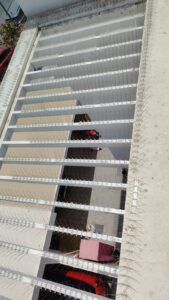
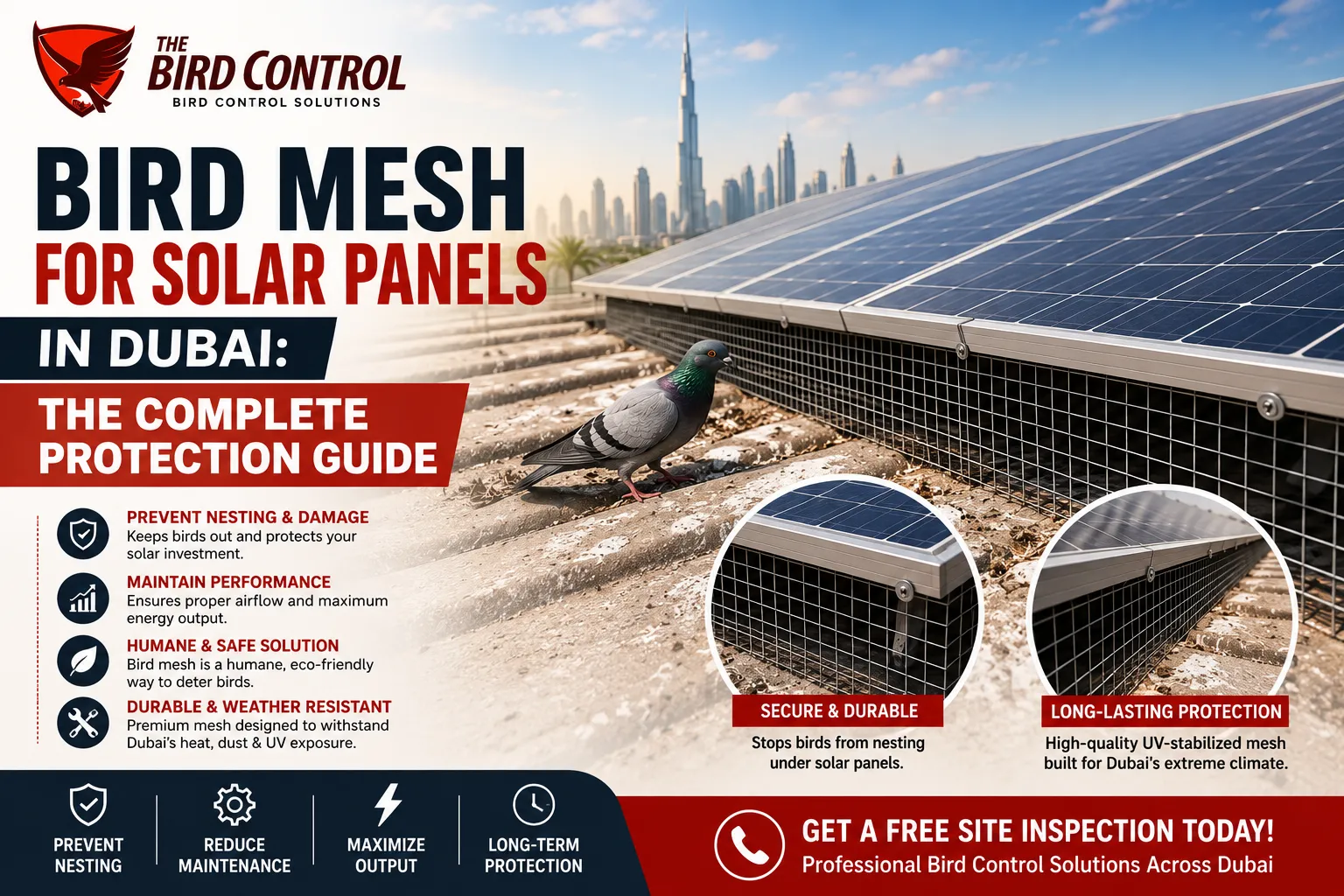
You climbed up to check your solar output and found a nest, a scatter of droppings, and feathers wedged between the panel frame and the roof. If that’s how you ended up here, you’re not dealing with an unusual problem — it’s one of the most common service calls we get from villa owners and facility managers across Dubai once a solar array has been up for more than a season.
The question that follows is almost always the same: what actually stops birds from getting under the array — and is bird mesh for solar panels the right solution? The short answer is yes, mesh is the primary fix, because it seals the actual entry point birds are using. Getting it right matters, because the wrong product leaves the real gap wide open while you’ve spent money solving the wrong problem.
Quick answer: The open gap underneath a raised solar array is what birds are actually entering — and that gap needs a properly fitted perimeter mesh or skirt to seal it. Spikes play a supporting role on exposed mounting rails, frame edges, and adjacent rooftop ledges, but mesh is what does the real exclusion work. The two together, correctly applied, is what permanently stops the problem.
Why Do Birds Keep Getting Under Solar Panels in Dubai?
A raised solar array is, from a bird’s point of view, close to ideal real estate. Panels are mounted on tilted frames a few centimetres to half a metre above the roof surface, which creates a shaded, enclosed cavity that stays noticeably cooler than the surrounding rooftop. In a climate where surface temperatures regularly pass 60°C in direct sun, that shade is a meaningful draw on its own.
The space also offers shelter from rain, wind, and direct sun, while sitting high enough off the ground to feel protected from cats and other ground predators — exactly the combination pigeons look for when choosing a nesting site. Once one pair successfully nests under an array undisturbed, the site tends to get reused and expanded season after season, which is why arrays left unprotected for a year or two often end up with multiple nests rather than just one.
Commercial and warehouse-scale arrays see the same pattern, just at larger scale — more panels means more gap edges and more potential entry points along the perimeter, which is part of why larger installations tend to attract more aggressive nesting activity if they’re left unprotected during the first year.
Activity also tends to follow a seasonal pattern rather than staying constant year-round. Nesting attempts typically increase during the cooler months when pigeons are most active breeding, but the shelter an array provides from peak summer heat means some birds treat the space as a year-round retreat rather than a seasonal nesting site. This is part of why removing a single nest without sealing the entry point almost always results in birds returning within weeks — the underlying reason they chose that spot hasn’t changed, only the temporary occupant has.
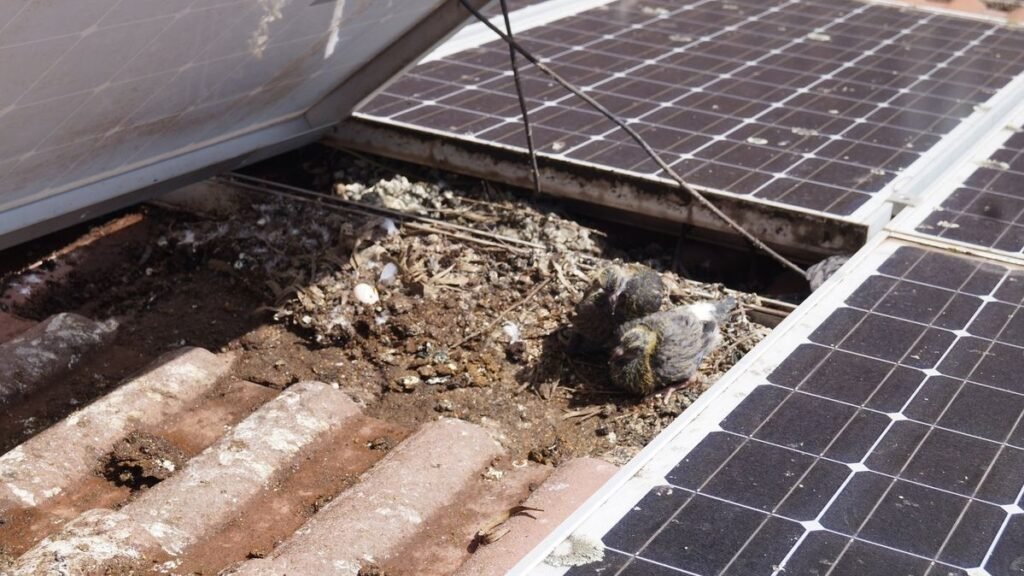
What Damage Can Bird Nesting Actually Do to a Solar Panel System?
This is the part that often surprises property owners — the issue isn’t just mess, it’s measurable performance and safety risk. We cover exactly how acidic droppings corrode fixtures and surfaces in more detail in our guide on whether bird droppings damage AC units in Dubai — the same corrosive chemistry applies directly to solar mounting hardware.
Reduced output. Droppings and feather debris that accumulate on the panel surface itself block sunlight from reaching the cells, which directly lowers energy output. Even partial shading from debris on a single panel can drag down the output of an entire series-connected string, not just the one affected panel.
Heat buildup. Solar panels rely on airflow underneath the frame to stay within their rated operating temperature. Nesting material packed into that gap blocks ventilation, and panels that run hotter than designed lose efficiency and degrade faster over their lifespan.
Wiring and fire risk. Dry nesting material sitting close to junction boxes, connectors, and DC wiring is a genuine fire hazard, particularly given how much heat builds up in that cavity during summer. This is one of the more serious reasons solar installers take bird activity seriously rather than treating it as a cosmetic nuisance.
Corrosion on mounting hardware. Bird droppings are acidic, and sustained exposure accelerates corrosion on aluminium rails, clamps, and steel fixings over time, which can eventually affect the structural integrity of the mounting system.
Blocked drainage. Nesting debris that washes toward roof drains during rain can contribute to pooling water, which creates its own set of roofing problems separate from the solar system itself.
Secondary pest activity. Established nests frequently bring mites, lice, and other parasites along with them, which can spread beyond the immediate nesting area to nearby roof spaces, storage areas, or — on villa properties — into roof access points connected to the rest of the building. This is one of the more practical reasons to deal with nesting activity early rather than after it has been established for a season or two.
None of this happens overnight, which is exactly why the problem so often gets ignored until output has already dropped or a maintenance technician flags it during a routine check.
Why Bird Mesh Is the Primary Solution for Solar Panels
Here’s where we’ll be direct: the problem under a solar array isn’t a flat surface birds are landing on — it’s an open gap they’re flying or walking directly into. That distinction matters because it determines which product actually solves the problem.
Spikes work by removing a flat landing surface, which is exactly the right tool for a ledge, a parapet, or a railing. But there is no flat landing surface to remove under a solar panel — there’s an open gap. Placing spikes at that entry point doesn’t close the gap. It leaves birds exactly the access they need.
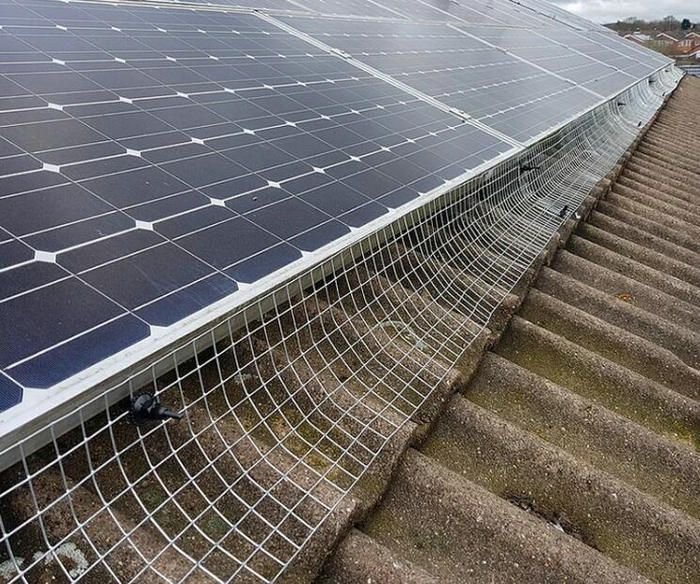
What actually closes that gap is bird mesh for solar panels — a mesh skirt or solid perimeter edging fixed around the full raised edge of the array, sealing the underside while still allowing the airflow the panels need to stay cool. You can read more about how solar mesh holds up long term in Dubai’s climate on our wire mesh in Dubai guide. This is the component that physically prevents entry in the first place, which is why we always start with mesh on solar installations rather than treating it as an optional add-on.
Spikes still have a real supporting role in a complete solar bird-proofing job — they go on the exposed flat surfaces around and within the array, mounting rail tops, frame edges, and any adjacent rooftop ledge or parapet wall birds use as a staging point before approaching the panels. Used this way, spikes complement the mesh rather than replacing it. We cover the spike side of this in more detail on our bird spikes vs netting comparison page.
How Does Solar Panel Bird Mesh Actually Work?
Bird mesh for solar panels is a rigid or semi-rigid barrier fixed directly to the existing mounting rail system around the full perimeter of the array. It seals the gap between the bottom edge of the panel frame and the roof surface, blocking the entry point birds use to access the cavity underneath.
A correctly specified solar mesh uses an open weave that lets air pass through freely — this is important because panels need that airflow beneath the frame to stay within their rated operating temperature. Sealing the gap with a solid material would trap heat and reduce performance, which is why purpose-made solar perimeter mesh is specified differently from standard garden netting or solid skirting products.
The mesh attaches to the mounting rails the panels are already clamped to, which means no drilling into the panel frame itself and no interference with manufacturer warranty terms. This is a detail that matters more than it might seem — we explain it further in the warranty section below.
Bird Mesh vs Bird Spikes for Solar Panels: Which Do You Actually Need?
The honest answer is that most solar installations need both — but they serve different functions and go in different places.
Use mesh when:
- There is an open gap underneath the panel frame that birds can walk or fly into
- You need to physically exclude birds from the cavity entirely, not just discourage landing
- The array has already had nesting activity and you need to seal the access point permanently
Use spikes when:
- Birds are landing on flat mounting rails, frame edges, or panel corners
- There is an adjacent rooftop ledge or parapet near the array that birds are using as a perch before approaching the panels
- You want a low-profile addition that does not change the array’s appearance from ground level
In practice, a properly fitted perimeter mesh handles the primary exclusion work, and spikes on the surrounding flat surfaces close off the secondary landing spots the mesh does not cover. For more detail on how we decide between these two across different property types, our bird spikes in Dubai service page covers the spike side of that decision in more depth.
Where Exactly Should Bird Mesh Be Installed on a Solar Array?
A correctly specified job covers several consistent points on almost every installation we handle:
- The full perimeter gap beneath the raised edge of the array — this is the primary exclusion point where mesh does the actual work
- Corners of the array, which see disproportionately high nesting activity since they offer extra shelter on two sides at once
- Any sections where cable routing creates a gap in the perimeter — these are the most common failure points on poorly fitted installations
- Mounting rail tops and frame edges, where spikes complement the mesh by preventing birds from staging before approaching the gap
- Adjacent parapet walls or rooftop ledges within a metre or two of the array, since these function as launch points for birds targeting the panels
- Inverter housings or junction box enclosures nearby, if they offer a sheltered cavity birds could use as a secondary nesting spot
Coverage gaps are the single most common reason a solar panel bird mesh installation fails — a skirt missing even one corner, or a section left open for cable routing, gives birds exactly the entry point they need to get back in.
Is Solar Panel Bird Mesh Different From Standard Bird Netting?
Yes, and the difference matters for both performance and longevity. Standard garden netting or lightweight bird netting is not appropriate for solar panel perimeter use for several reasons.
Solar perimeter mesh needs to be rigid enough to hold its shape against the panel frame without sagging, which lightweight netting cannot do over time. It also needs to be UV-stabilised to handle Dubai’s sun exposure without degrading, and the weave needs to be open enough to allow airflow while still being tight enough to exclude birds. Purpose-made solar mesh or rigid wire mesh products meet these requirements. Lightweight netting does not, which is why installations using the wrong material typically fail within a season or two as the material degrades and sags away from the frame.
Will Bird Mesh Affect My Solar Panel Warranty?
This is a fair concern and worth addressing clearly. Most solar panel warranties are voided by drilling into the panel frame itself or by mounting hardware that interferes with the panel’s electrical components or factory mounting points.
A correctly executed solar panel bird mesh installation avoids this entirely by attaching fixings to the existing mounting rail system — the same rails the panels are already clamped to — rather than to the panels themselves. This means the mesh is added without modifying or drilling into any panel, which keeps manufacturer warranty terms intact. If you are working with an installer who is not familiar with solar mounting systems specifically, it is worth confirming this point before any work begins, since this is exactly where a generic approach can create an expensive problem that has nothing to do with birds.
Can Bird Mesh Be Installed on Rooftop, Villa, and Warehouse Solar Arrays in Dubai?
Yes, though the scale and approach shift depending on the type of installation.
Villa rooftop arrays are the most common job we see — a single residential array, usually with a handful of access points around the perimeter, where a custom-cut mesh skirt covers the full exclusion job in a single visit.
Commercial and warehouse rooftop arrays are larger in scale but follow the same core approach — more linear metres of perimeter mesh and a proportionally larger number of locations to cover, often requiring proper rooftop access equipment given the size of commercial roof surfaces.
Ground-mounted arrays, less common but present on some larger commercial sites, present a slightly different challenge since the access points run along the ground-level perimeter rather than a rooftop edge, but the same exclusion principle — seal the gap with mesh — still applies.
Across all property types, the consistent factor is that the mesh needs to be assessed and cut against the specific array’s mounting height and perimeter length. Off-the-shelf sizing rarely fits cleanly given how much solar mounting heights vary between manufacturers and installers.
How Long Does Solar Panel Bird Mesh Installation Take?
A typical villa-scale job runs through four stages. First, an on-site assessment measures the actual gap height and perimeter length of the array and checks for any existing nesting activity. Second, mesh sections are custom-cut to the measurements taken. Third, mesh is fitted directly onto the rail system around the full perimeter. Fourth, if an existing nest is present, it is removed and the area is cleaned before the mesh goes in — sealing an active nest without clearing it first just traps debris inside the cavity rather than solving anything.
Most villa-scale installations are completed within a single visit. Larger commercial or warehouse arrays with significantly more perimeter length may need a full day depending on access requirements and the total area being covered.
How Much Maintenance Does Solar Panel Bird Mesh Need?
Once mesh is properly fitted, maintenance is minimal. The main task is an occasional check that dust and sand buildup — unavoidable in Dubai — has not started restricting airflow through the mesh, since the panels still need that ventilation to perform properly. An annual inspection alongside your regular solar system maintenance is usually enough to catch any sections that have shifted or need clearing. Well-fitted solar mesh does not require replacement on any predictable schedule the way gel or scare-device alternatives do.
Frequently Asked Questions
Q: Will bird mesh around my solar panels reduce airflow and affect performance?
A: Correctly specified solar mesh uses an open weave designed to let air pass through freely while still blocking birds, so properly fitted protection does not meaningfully restrict the cooling airflow panels need.
Q: What happens to an existing nest when the mesh goes in?
A: Active nests are removed and the area is cleaned before mesh is fitted, so debris is not sealed inside the cavity.
Q: Can bird mesh be added to panels that are already installed?
A: It can be added at any point after the panels are up — most of our solar panel bird mesh jobs are retrofits on existing arrays where nesting has already started.
Q: Do pigeons cause more solar panel problems than other birds in Dubai?
A: Yes, pigeons are responsible for the large majority of nesting activity under solar arrays here, given their size, persistence, and preference for sheltered, elevated nesting spots.
Q: How do I know if birds are already under my panels without climbing up to check?
A: Common signs include droppings on the roof surface below the array’s edge, a visible drop in your system’s reported energy output, or audible bird activity near the panels in early morning.
Q: Does bird mesh work the same way on tile roofs versus flat concrete roofs?
A: Yes, the mounting rail system the mesh attaches to is largely consistent regardless of roof type, since the fixings go onto the rail rather than the roof surface itself.
Q: Can birds chew or peck through the mesh over time?
A: Quality solar perimeter mesh is metal or heavy-duty UV-stabilised material specifically chosen to resist this, unlike lightweight garden netting which birds and rodents can eventually work through.
Q: Is solar panel bird mesh a one-time cost, or does it need redoing periodically?
A: When correctly fitted to the array’s mounting system, it is a one-time installation — there is no scheduled replacement the way there is with gel deterrents or scare devices.
The Bottom Line
If birds have found their way under your solar array, bird mesh for solar panels is the primary fix — it seals the actual entry point that spikes alone cannot close. Done correctly, the mesh is permanent, does not affect your warranty, and does not interfere with the airflow your system needs to perform.
If you have found droppings, nesting material, or a noticeable drop in output from your array, the fastest way to find out exactly what your installation needs is a short on-site assessment. You can read more about how we work across Dubai on our about us page, or get in touch to book a free inspection. If you want to understand how mesh compares to other bird control methods, our guide on whether bird spikes really work in Dubai’s climate covers the full comparison.