If you’ve ever stepped onto your balcony and been greeted by a mess of droppings, feathers, and that unmistakable cooing from somewhere just out of sight, you’re not alone. Across Dubai — from Marina towers to Jumeirah villas — property owners are fighting the same quiet battle with pigeons, and losing more often than not.
The usual response is to clean it up and hope it doesn’t happen again. It always does. The birds aren’t visiting — they’ve found a ledge, a beam, or an AC unit they consider prime real estate, and they’ll keep coming back until that spot stops being landable.
That’s really the whole idea behind bird spikes: not scaring birds away, but making the surface itself uninteresting to land on — a method the RSPB lists among the accepted humane bird deterrents, as opposed to poisons or trapping.
Quick answer: Bird spikes are rows of blunt rods fixed to ledges, parapets, and rooftop edges that make landing physically uncomfortable for pigeons and other birds — without harming them. In Dubai, stainless steel spikes typically last over a decade and plastic (polycarbonate) spikes 5–10 years, depending on sun and heat exposure. Professional installation matters more than the spike material itself, since even small gaps let birds back in.
What’s Actually Happening on Your Ledge
Pigeons and mynas don’t pick perches randomly. They look for flat, sheltered, elevated surfaces — exactly what window ledges, parapets, and rooftop edges in most Dubai buildings offer in abundance. Once a pair settles in, they tend to return to the same spot repeatedly, and nesting can follow within weeks. For a broader look at why this happens across the city, see our overview of bird control in Dubai.
One recent commercial job involved nine aluminum shades on a Dubai building where birds had been landing and fouling the structure consistently. We installed five-finger spike strips, glue-fixed for a heat- and water-resistant hold, with crane access needed to reach the higher sections — the kind of job that shows why proper installation, not just the spikes themselves, is what actually solves the problem.
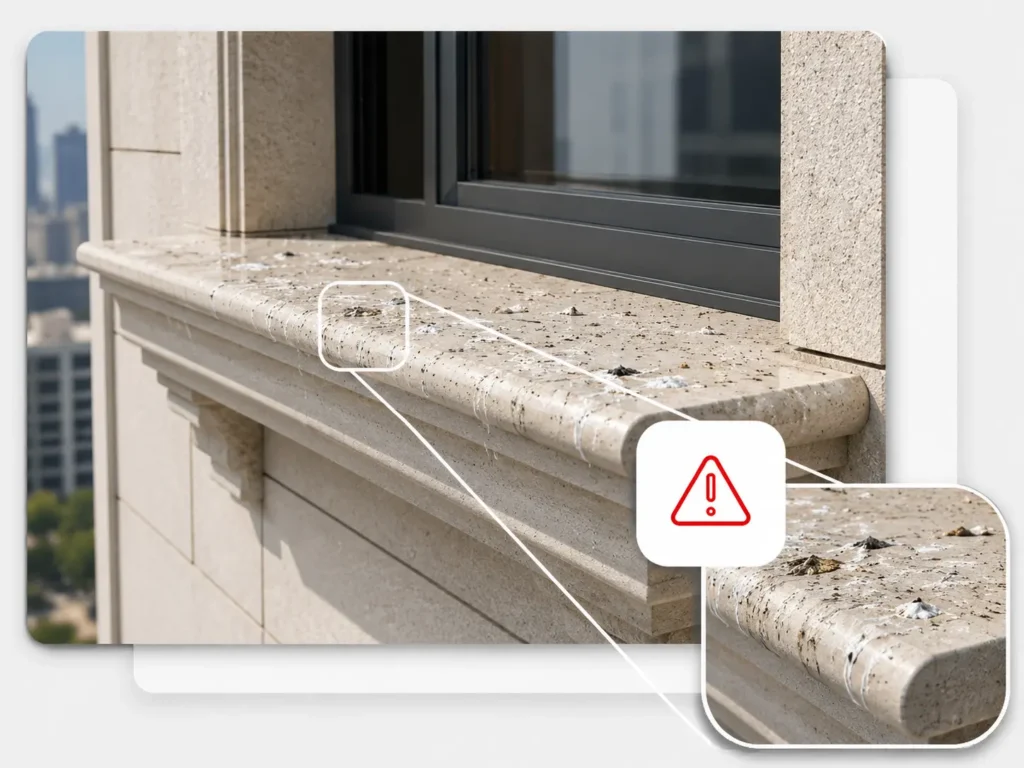
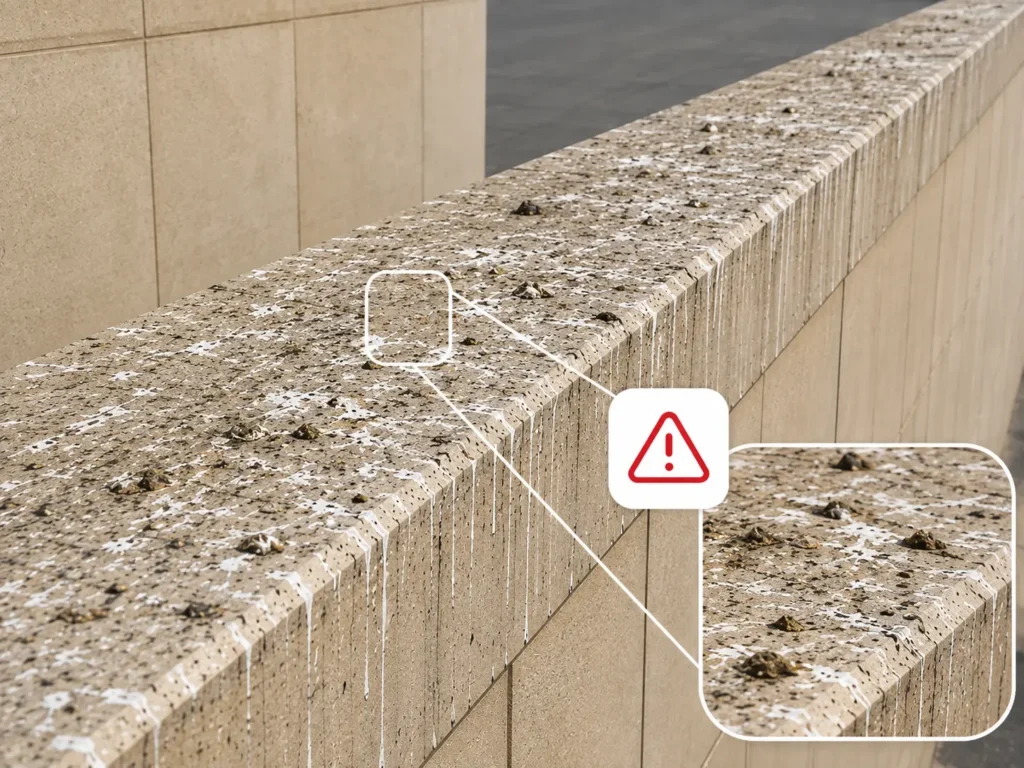
The droppings aren’t just unsightly. Left to build up, they’re mildly acidic and can degrade paint, sealant, and even structural coatings over time — a bigger deal in Dubai’s heat, where materials are already under thermal stress.
How Spikes Break the Cycle
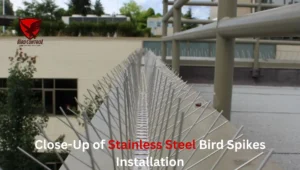
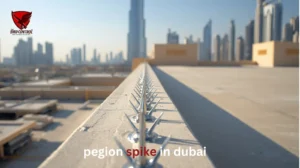
A spike strip is about as low-tech as bird control gets: a row of blunt rods fixed along the ledge that makes it physically awkward for a bird to land, without ever hurting it. No sound, no chemicals, no trapping — the bird simply looks elsewhere.
They tend to work best on:
- Narrow, linear surfaces — window sills, parapets, signage edges
- Rooftop perimeters and AC unit tops
- Balcony railings and beams
For wider open spaces like a full balcony or courtyard, bird netting usually does a better job than spikes alone — worth keeping in mind if your bird problem is more “living there” than “perching there.” If you’re weighing the two options directly, our spikes vs. netting vs. pigeon spikes comparison breaks down which fits which situation.
Steel or Plastic? It Comes Down to Where and How Long
Both materials work, but the right pick depends on the location and budget. In short: stainless steel holds up longest against Dubai’s sun and coastal humidity and suits rooftops and long-term commercial installs, while polycarbonate (plastic) costs less upfront and suits smaller residential jobs, with a shorter lifespan under Dubai’s summer heat. For the full breakdown on each, see our dedicated guides on stainless steel bird spikes and plastic bird spikes in Dubai.
Which Bird Is Actually the Problem?
Dubai’s most common problem birds don’t all behave the same way, and spike spacing needs to match the species — a configuration that stops pigeons won’t necessarily stop a myna.
- Feral pigeons — the most common complaint across Dubai residential towers. They favor wide, flat ledges and rooftop AC units, and respond well to standard wide-gauge spikes.
- Common mynas — smaller and more aggressive than pigeons, mynas can squeeze into gaps a pigeon spike layout would miss. They need narrower spike spacing, particularly around balcony beams and shaded corners.
- House crows — a persistent issue in older neighborhoods like Deira and Bur Dubai. Crows are intelligent enough to test a spike installation for weak points, so full-perimeter coverage matters more here than with pigeons.
- Seagulls — mainly a concern for waterfront properties along the Marina, JBR, and the Creek, where wider wingspan birds need taller, more widely spaced spikes than standard pigeon configurations.
Misidentifying the bird is one of the more common reasons a spike installation “doesn’t work” — it’s usually not a failed product, it’s the wrong spacing for the species actually using the ledge.
What Drives the Cost of Spike Installation in Dubai
Pricing isn’t one-size-fits-all, and a few factors specific to Dubai properties tend to move the number more than people expect:
- Ledge length and surface count — priced per linear meter in most cases; a single balcony railing costs far less than a full rooftop perimeter.
- Access difficulty — ground-floor and low-rise balconies are straightforward, but high-rise rooftop or facade work in towers along Sheikh Zayed Road or the Marina often needs rope access or a cherry picker, which adds to labor cost.
- Material choice — stainless steel costs more upfront than polycarbonate but needs replacing far less often, so the lifetime cost is often lower despite the higher initial quote.
- Surface type — mounting on glass railings or stone facades (common in villa compounds) sometimes needs a different fixing method than standard concrete ledges, which can affect price.
Because of this spread, an accurate quote really does require an on-site look rather than a flat per-property estimate — which is why most reputable installers, including us, offer a free inspection before pricing anything.
Why Professional Installation Matters
It’s tempting to grab a spike strip online and stick it on yourself. The problem is coverage, not the spikes themselves — even a small gap in the line is enough for a determined pigeon to exploit. For a full walkthrough of what proper installation actually involves, see our step-by-step bird spike installation guide.
A Few Honest Answers to Common Questions
Do bird spikes hurt the birds? No — they’re blunt-tipped and designed purely to make landing uncomfortable, never to injure. See our full explainer on whether bird spikes hurt birds for the complete welfare picture, including how spikes compare to poisons and trapping.
Will the spikes be visible from the street or a neighboring balcony? Modern low-profile spike strips sit close to the ledge and are typically 5–10cm tall, in colors matched to the building material (clear, white, or black are most common). From ground level or a distance of more than a few meters, most people don’t notice them unless they’re specifically looking. Visibility is more of a concern up close — for heritage facades or highly visible signage, a bird wire system is sometimes preferred instead, since the wire is nearly invisible even at close range.
How long does installation actually take? For a typical residential balcony or set of window ledges, installation usually takes half a day to a full day, including the initial site assessment. Larger jobs — a full rooftop perimeter on a commercial building, for example — can take one to two days depending on ledge length, access difficulty (crane or rope access adds time), and whether multiple surface types are involved. Weather isn’t usually a factor in Dubai given the climate, though we avoid installation during peak midday heat in summer months for both material handling and technician safety.
Keeping Spikes Working Through Dubai’s Seasons
Spikes are low-maintenance, but Dubai’s climate does put a few things on the checklist that wouldn’t matter in a milder city:
- After sandstorms — dust buildup between spike rows can create a temporary landing surface; a quick rinse restores full effectiveness.
- Before nesting season (typically late autumn through winter in Dubai, when pigeon and myna activity increases) — a fast visual check confirms no sections have loosened or been dislodged.
- After heavy rain events — check adhesive-mounted sections in particular, since sudden humidity swings can affect bonding on some surfaces.
- Annually — a full inspection catches UV degradation on plastic spikes before it becomes a gap birds can exploit.
None of this requires a professional visit every time — most of it is a five-minute check from a resident or building maintenance staff. It’s really just about catching small issues before they turn into birds resettling in.
The Bottom Line
Bird spikes aren’t a cure-all, but for the specific problem of birds perching and nesting on ledges, they’re one of the few genuinely permanent fixes available — install once, and the problem largely stops recurring. If birds are getting into an enclosed space rather than just landing on an edge, pairing spikes with netting usually closes the gap completely. See our full bird control services in Dubai for how spikes, netting, and wire systems compare side by side.
If you’re dealing with a recurring pigeon problem and want an honest read on which method actually fits your property, a quick on-site look is usually more useful than guessing from photos — get in touch for a free inspection.