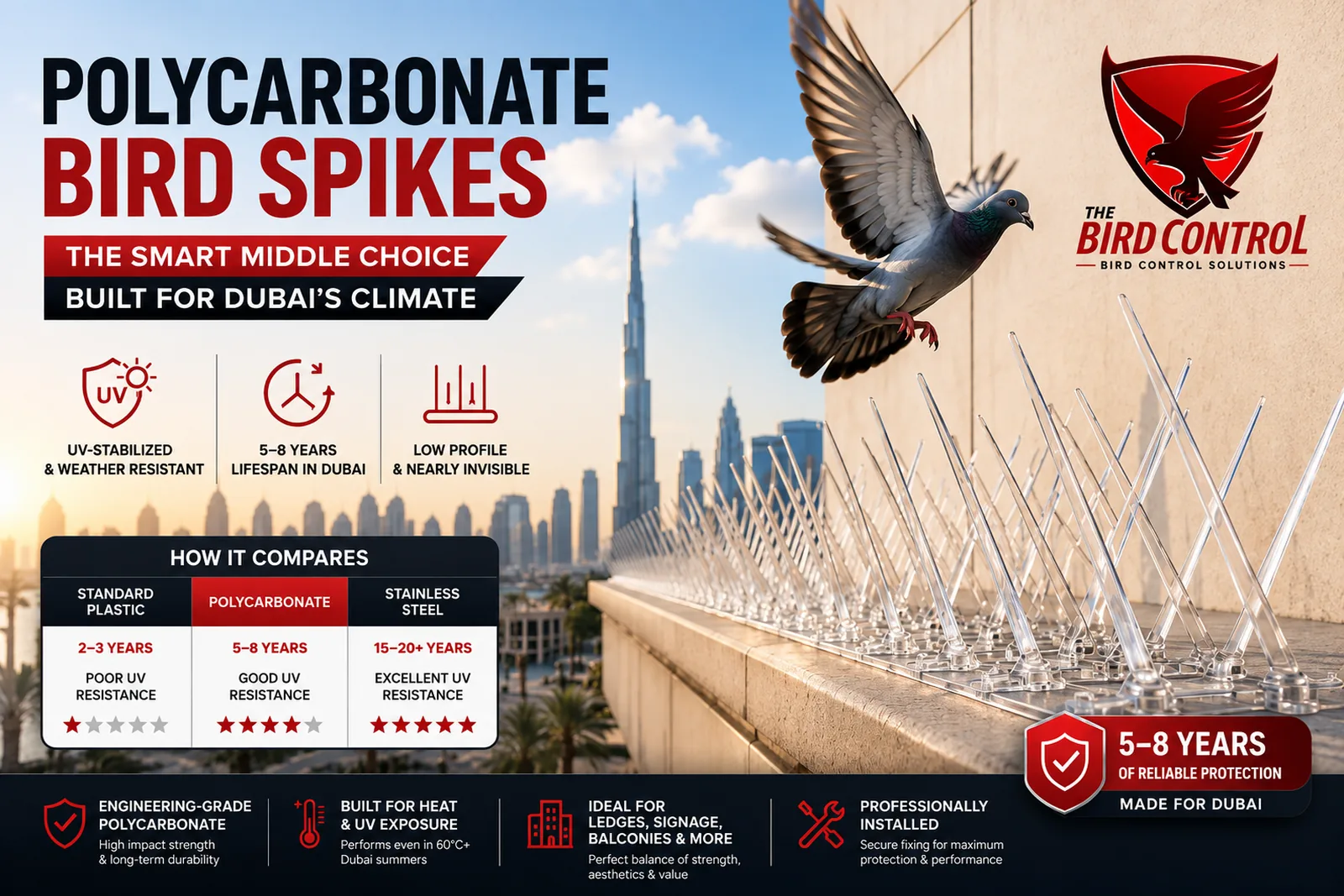
Quick answer: Polycarbonate bird spikes are UV-stabilized plastic spike strips molded from the same material used in Dubai’s bus shelter roofing and machine safety guards. They sit between standard plastic spikes and stainless steel on both price and lifespan, typically running 5–8 years outdoors here versus 2–3 years for uncoated plastic and 15+ for marine-grade steel. Because the material is engineered to resist UV embrittlement, it’s the pragmatic middle choice for ledges, signage, and balconies that get direct sun but don’t need the load-bearing strength steel offers — like AC condenser units or heavy warehouse beams. This is one of several spike materials covered in our main bird spike in Dubai overview.
What Makes Polycarbonate Different From “Plastic” Spikes
Every polycarbonate spike is technically a plastic spike, but not every plastic spike is polycarbonate — and in Dubai’s climate, that distinction is the whole story.
Generic bird spikes sold as “plastic” are usually injection-molded from unstabilized polypropylene or ABS. Without UV inhibitors, these resins undergo photo-oxidation under sustained sun exposure: the polymer chains break down, the plastic yellows, and the spikes turn brittle and snap within a season or two of Gulf summer. We cover this failure pattern in more detail in our breakdown of plastic bird spikes in Dubai.
Polycarbonate is a different polymer family entirely — the same engineering-grade thermoplastic used in eyewear lenses, riot shields, and skylights. It has a naturally higher impact resistance and, critically, accepts UV-stabilizing additives that keep it from degrading anywhere near as fast. According to the British Plastics Federation, polycarbonate retains its mechanical properties across a wide temperature range and resists the yellowing and cracking that plague lower-grade plastics under prolonged UV load — exactly the stress profile a Dubai rooftop sees eight months of the year.
Polycarbonate vs. Plastic vs. Stainless Steel: Where It Actually Fits
We get asked constantly whether to just skip straight to steel. The honest answer depends on the surface, not a blanket “steel is always better” rule.
| Factor | Standard Plastic | Polycarbonate | Stainless Steel |
|---|---|---|---|
| Typical lifespan in Dubai sun | 2–3 years | 5–8 years | 15–20+ years |
| UV resistance | Poor — yellows and cracks | Good, if UV-stabilized grade | Excellent (not UV-affected) |
| Load-bearing strength | Low | Moderate | High |
| Visibility on light stone/glass | Low profile, blends in | Low profile, blends in | More visible, reflective |
| Cost per linear meter (installed) | Lowest | Mid-range | Highest |
| Best surfaces | Short-term / rental balconies | Villa ledges, signage, canopies, window sills | AC units, warehouse beams, solar frames, parapets |
Polycarbonate earns its place on surfaces that need more resilience than throwaway plastic but don’t carry heavy bird pressure or structural load — think villa parapets, shaded balcony rails, and signage where a nearly invisible spike matters aesthetically. For a deeper side-by-side across all three materials plus netting, see our full comparison: bird spikes vs. netting vs. pigeon spikes in Dubai.
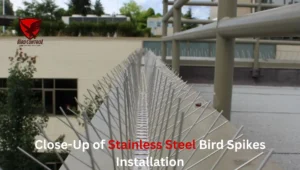
For high-load, high-pressure zones — AC condenser tops, warehouse roof beams, or solar panel edges where heavier crows and falcons perch — we still default to stainless steel bird spikes, covered separately in our warehouse bird spikes guide and bird mesh for solar panels post.
How Polycarbonate Spikes Hold Up Through a Dubai Summer
We’ve pulled spike strips off client buildings for inspection after full seasons in place, and the pattern is consistent:
Months 1–12: No visible change. Spikes stay flexible, base adhesive or screws hold, no discoloration.
Year 2–3: Slight surface dulling on south- and west-facing installs (the highest UV exposure sides of a building). Mechanical performance unaffected — spikes still deflect birds normally.
Year 4–6: This is where UV-stabilized polycarbonate separates from ordinary plastic. Non-stabilized plastic is usually cracking and snapping by this point; a properly specified polycarbonate strip is typically still intact, though base flexibility starts to reduce slightly, and the tips can become marginally more brittle at the very end of this window.
Year 7+: Replacement becomes worthwhile on high-exposure runs (rooftop parapets, west-facing ledges). Shaded or partially covered runs — under a canopy, on a north-facing balcony — often keep performing well past this point.
Heat matters as much as UV. Ambient surface temperatures on unshaded Dubai concrete regularly exceed 60°C in July and August. Polycarbonate has a higher heat-deflection temperature than commodity plastics, which is part of why it doesn’t slump or warp the way cheaper resin spikes can on a black-painted ledge at midday.
Where We Install Polycarbonate Spikes Most Often
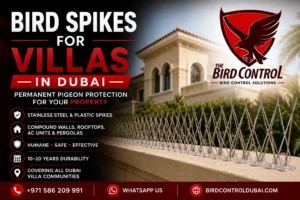
- Villa parapets and balcony rails — see our dedicated guide on bird spikes for villas in Dubai
- Shopfront signage and awnings — low visual profile keeps branding clean
- Window sills and ledges on residential towers — where full steel would be overkill for light pigeon pressure
- Shaded courtyard beams and pergolas — UV load is lower here, so lifespan comfortably exceeds the summer-facing figures above
- Balcony rails alongside netting — often paired with balcony bird netting installs for full coverage
We generally steer clients away from polycarbonate on bare AC condenser coils and rooftop plant equipment — the combination of reflected heat, vibration, and higher bird-landing force makes steel the better long-term spend there. See our notes on stopping bird nesting on AC units for that specific case.
Installation
Polycarbonate spike strips install the same way as standard plastic ones: a UV-rated adhesive bead or stainless screws into the base rail, spaced to leave no gap wider than a landing bird’s foot span (roughly 4–5 cm for pigeons, tighter for mynas). Curved ledges need pre-cut or flexible-base strips rather than forcing a straight strip to bend, which stresses the polymer at the bend point and shortens its life. Full step-by-step guidance, including surface prep and spacing, is in our how to install bird spikes guide.
Adhesive-mounted runs on smooth stone or glass tend to fail earlier than screw-fixed runs — heat cycling loosens adhesive bonds faster than it loosens a mechanical fastener. If your ledge sees full sun, we recommend screw-fixing wherever the substrate allows it.
Cost Factors
Polycarbonate spikes typically price between standard plastic and stainless steel per linear meter, both for material and installed cost, since labor time is roughly the same across all three materials — the price gap is almost entirely in the raw material and expected replacement cycle. Over a 6-year horizon on a moderate-exposure surface, polycarbonate often works out cheaper than plastic (which needs replacing 2–3 times in that window) while costing less upfront than steel. On heavy-exposure, high-value, or hard-to-access surfaces (parapets on a 20-story tower, for instance), the steel install usually wins on total cost of ownership once you factor in scaffold or rope-access charges for repeat plastic replacement.
If you’re unsure who’s responsible for that cost on a rented property, our guide on who pays for bird spikes — landlord or tenant walks through the UAE tenancy angle.
Are Polycarbonate Spikes Humane?
Yes — like all correctly specified bird spikes, polycarbonate strips are a deterrent, not a trap. They’re blunt-tipped, spaced to prevent landing rather than to injure, and don’t harm birds that brush against them; they simply remove the flat perching surface. We go into the welfare question in more detail, including third-party animal welfare positions, in do bird spikes hurt birds?
FAQ
Do polycarbonate bird spikes turn yellow in Dubai sun? UV-stabilized polycarbonate resists yellowing far better than standard plastic, though some surface dulling on south- and west-facing installs is normal after 2–3 years. Non-stabilized “plastic” spikes sold without a UV rating yellow and crack much sooner — always confirm UV stabilization before buying.
How long do polycarbonate bird spikes last outdoors in the UAE? Expect 5–8 years on full-sun exposure and longer on shaded or partially covered runs. This sits well above standard plastic (2–3 years) and below marine-grade stainless steel (15–20+ years).
Are polycarbonate spikes strong enough for pigeons and crows? Yes for pigeons and mynas on light-to-moderate perching pressure. For crows, falcons, or high-traffic roosting sites, stainless steel is the more durable choice due to its higher load tolerance.
Can polycarbonate spikes be installed on curved ledges? Yes, using pre-curved or flexible-base strips. Forcing a straight strip around a tight curve stresses the material at the bend and shortens its lifespan.
Are polycarbonate bird spikes more expensive than plastic? Per linear meter, yes — but because they last roughly 2–3 times longer, the effective cost over a 5–6 year period is often lower than repeatedly replacing standard plastic spikes.
Get a Site-Specific Recommendation
Every ledge, balcony, and rooftop faces different sun exposure and bird pressure, so the right material varies even across the same building. If you’re comparing options for your property, our team can assess the surface and recommend polycarbonate, steel, or a mixed approach — see how we compare to other providers in our guide to top bird control companies in Dubai, or get in touch for a free site assessment.
If pigeons are the main pressure on your property rather than crows or mynas, our Dubai pigeon control guide covers the full toolkit beyond spikes. And for a broader look at bird control options across Dubai properties — spikes, netting, and deterrents together — start with our bird control in Dubai hub page.